
Overview
Alabama Symphony OThe French Connection: April 23, 2026, Carver Theatre
In the early 20th century, there was no more happening place for an artist than Paris. In the years after the First World War, the city attracted a veritable who’s who of creatives—Pablo Picasso, Henri Matisse, Gertrude Stein, Ernest Hemingway, Claude Debussy, Cole Porter—all of whom called Paris their home, as did the three composers featured on this program.
Arts culture in early 20th-century Paris was very different from that of other major European centers at the time. While the long-standing musical meccas of Germany and Austria grappled with something of an identity crisis—where could music go now that Mahler and Strauss had pushed tonality to its limits?—Paris emerged as a hub of internationalism and creative cross-pollination.
Take the Ballets Russes, for example: the famous company founded by Russian impresario Sergei Diaghilev, who sought to present Russian ballet tradition to the western world. At the Ballets Russes, you might have seen stars like Vaslav Nijinsky and Anna Pavlova dancing choreography by George Balanchine (later the founder of the New York City Ballet), accompanied by scores from composers like Igor Stravinsky and Claude Debussy, with costumes by Coco Chanel and sets designed by Pablo Picasso. Ballet in general played a large role in uniting artistic disciplines. Each of the composers on this program wrote extensively for ballet, and the influence of dance on their music is apparent.
For American artists in particular, a stint in Paris came to be seen as a kind of rite of passage, with figures like Aaron Copland and George Gershwin spending significant time studying there. But there was another import from the United States that would make an enormous mark on French art: jazz.
Jazz first came to Paris via American military bands during the First World War. After the war, many African American servicemen chose to remain in France rather than return to the racial segregation of Jim Crow America, and before long Paris had become something of an outpost for the Harlem Renaissance, attracting artists like Langston Hughes and Josephine Baker. Parisians weren’t entirely sure what to make of this new art form. Many saw it as low brow and elementary compared with more traditional European art music. But those who understood the true complexities of jazz harmony quickly became enamored. Jazz clubs grew to be central pillars of Parisian artistic life, serving as meeting places where artists could rub elbows and exchange ideas. Before long, these new sounds moved from dark, smokey rooms to concert halls, ballet stages, and art exhibits.
The influx of international voices, coupled with already-established trends like Impressionism and the rise of Neoclassicism, amalgamated into a distinctly French sound characterized by lightness and transparency that was often seen as a rejoinder to what was perceived as the bombastic and pretentiously academic music coming out of Germany. Whether or not that assessment is merited, the resistance to it produced an eclectic and charming collection of music emblematic of this unique time and place.
Eight Instrumental Miniatures (1921/1962)
Igor Stravinsky (1882-1971)
Run Time: Approx. 8 minutes
Of the three composers on this program, Igor Stravinsky is likely the most well-known. For many, the name immediately conjures monumental works like The Firebird or The Rite of Spring. These have undoubtedly become his greatest hits, thanks in no small part to Disney’s Fantasia and Fantasia 2000, but these large-scale works represent only a sliver of a career defined by reinvention. Over the course of his life, Stravinsky’s output moved through several clearly defined phases. There was his early Russian primitivist and avant-garde period, his Neoclassical phase, and later an interest in twelve-tone serialism, each marking a distinct shift in his musical voice.
The Eight Instrumental Miniatures were originally written as easy piano exercises for students entitled The Five Fingers. The melody of each movement, played in the right hand, is made up of only five notes, so the player never needs to shift their hand position. The original left-hand accompaniment was very simple, usually limited to one or two notes at a time, providing basic harmonic support. The simple pieces offer a glimpse of Stravinsky at his most whimsical and understated, and the composer was clearly quite proud of them; he played them on his very first recording in 1925. However, when he returned to the work and orchestrated it in 1962, he was a very different composer. He had recently returned to Russia for the first time in nearly 50 years, and his style had undergone several significant evolutions in the interceding years. The orchestration, with its added voices and harmonies, offers a greater breadth of color and style, and flashes of his various explorations and reinventions shine through the texture.
While Eight Instrumental Miniatures retains the charm and playfulness of The Five Fingers, the choice of instruments and the way they are employed bring out aspects of Stravinsky’s more avant-garde periods. Perhaps most strikingly, he chooses an exceedingly odd collection of instruments: pairs of winds, one horn, and three pairs of strings. At times, this unusual voicing hints at his Russian primitivist voice. For instance, in the third movement, the tessitura of the horn sits higher than the flute and clarinet, resulting in a wailing quality not unlike the opening of The Rite of Spring. The angular, surprising rhythms in the final movement, too, sound more jarring and avant-garde when voiced by winds than in the solo piano version.
La création du monde, op. 81 (The Creation of the World) (1923)
Darius Milhaud (1892-1974)
Run Time: Approx. 19 minutes
Darius Milhaud took his interest in jazz a step further than many of his compatriots, traveling to America and the streets of Harlem in search of real authenticity. While there, he found inspiration not only in the music, but also in the broader African cultural and mythological traditions. Upon his return to Paris in 1923, the first major work to emerge from his experience was the ballet La création du monde (The Creation of the World).
Milhaud was not the only one interested in African culture and art. Losses from the war had shaken many people’s belief in the superiority of Western Civilization, sparking an interest in the exoticism of the French colonies. La création du monde draws on author Blaise Cendrars’ Anthologie nègre for its retelling of African creation legends. Cubist painter Ferdinand Léger, who was himself interested in primitive African art, designed the sets.
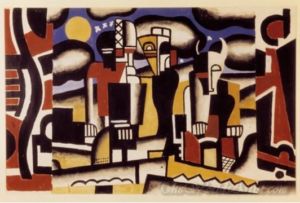
The ballet unfolds in five continuous sections, each depicting a stage of creation: chaos before the world’s beginning; the birth of plants and animals; the creation of man and woman; their awakening desire; and finally, a springtime scene of renewal, birth, and healing.
Perhaps the most obvious jazz transplant is the addition of the saxophone to the traditional orchestral complement. Its warbly voice infuses the music with an exoticism signaling that the Western world has been left behind. Throughout much of the work, a steady pulse, passed between the percussion, piano, and low strings, underlies the music, evoking the beat of a heart—the very essence of humanity.
Sinfonietta (1947)
Francis Poulenc (1899-1963)
Run Time: Approx. 28 minutes
Francis Poulenc was a late arrival to music. His father was a successful manufacturer who wanted his son to join the family business, barring him from entering conservatory training. He did study piano privately, and when his parents died, his piano teacher and mentor Richardo Viñes introduced him into the world of Paris’s burgeoning young musicians. Eventually, he joined up with a group of prominent composers that called themselves Les Six. Amongst his five compatriots was Darius Milhaud.
Poulenc was often dismissed by his contemporaries for writing music they viewed as “unserious,” that hewed too closely to the types of popular songs heard in saloons and burlesques. Poulenc, for his part, admitted to a love of what he referred to as the “adorable bad music,” owing, he said, to his mother’s affinity for it. Guilty pleasure though it may be, the infusion of this bubbly style gives his music a pleasing approachability. And if I may inject a personal observation: composers accused of unseriousness or kitsch are often guilty of nothing more than the power to write a really catchy tune.
I am, however, hesitant to describe this music as entirely unserious. The first movement is lush and earnest, with an intriguing combination of Broadway-esque flare, warm romanticism, and glassy Impressionistic textures colored by satisfying harp glissandos. The third movement, too, offers a gentle and contented Andante that employs the varied timbres of the wind section much like the impressionist painters deployed color.
Easy listening as it may be, the piece seems to capture the intrinsic spirit of the city—or at least our American view of it. It saunters by, effortless, unhurried, perhaps a little indulgent, and endlessly charming.
—Notes by Valerie Sly, 2026