Program Notes
Beyond the Forest, Into the Sky: May 15 & 16, 2026
Beyond the Forest, Into the Sky by the Alabama Symphony Orchestra
Prelude to Hänsel und Gretel (1893)
Engelbert Humperdinck (1854-1921)
Run time: Approx. 8 minutes
Engelbert Humperdinck is not a name that would appear today on a list of best-known composers. He did not cultivate a large compositional output, instead devoting much of his life to teaching, and as a result, Hänsel und Gretel stands somewhat alone in his legacy, making him a bit of a compositional one-hit wonder.
Though the majority of his small catalog missed out on lasting acclaim, Hänsel und Gretel has carved out a place as a beloved staple in the operatic repertoire. Its success and charm are perhaps a result of the unexpected combination of the whimsical fairytale and the very obvious influence of his idol and mentor, Richard Wagner.
If you’re not familiar with Wagner, there’s much to be said about his impact on theater and the scope of musical drama, but to keep this brief, let’s go with an image: conjure in your mind the most stereotypical picture of opera. Is it a robust woman wearing that quintessential horned helmet? Is she perhaps holding a spear? That unshakable image has come to caricaturize opera thanks to a costume from Wagner’s Ring Cycle. While grandeur is certainly a large part of the composer’s legacy, his most significant contribution lies in the craft of musical storytelling.
Wagner’s fingerprints are apparent in the shape of Humperdinck’s phrases—in the way they seem to go on forever, one connecting seamlessly to the next—the expansive layering of his textures, and, perhaps most importantly, in Humperdinck’s use of leitmotif, a technique Wagner invented to ensure thematic cohesion throughout his stories, even across multiple operas.
Leitmotif, which literally translates to “leading” or “guiding” motive, is a short musical idea that represents a person, place, or theme. One of the elements that makes the film scores of John Williams so effective, for example, is his use of leitmotif. Think of Darth Vader’s ominous march, or those menacing two notes that instantly signal Jaws, or the majestic Force theme that symbolizes Luke Skywalker’s destiny.
The prelude begins with one of the opera’s most significant leitmotifs, the evening prayer music. The wistful chorale appears throughout the opera, most prominently in the aria where the children say their bedtime prayers. It symbolizes the innocence of the children, protected by God.
The prayer is then interrupted by the witch’s theme, sounded in the trumpet with a cackling herald. Afterwards comes a gently meandering melody representing Hansel and Gretel’s journey through the woods and their accidental snacking on the witch’s candy house before they realize what trouble they’re in. Finally, there is the triumphant march heard when the children doom their evil captor to her broiled demise.
Humperdinck deftly weaves all of these themes together, at times layering all four atop one another and creating a delightfully complex musical palette—a masterful tribute to his mentor.
Symphony No. 40, K. 550, in G Minor (1788)
Wolfgang Amadeus Mozart (1756-1791)
Run time: Approx. 27 minutes
Early in my research on Mozart’s Symphony No. 40, I stumbled upon two quotes that brought my exploration of this beloved work to a standstill. I found myself unable to think past these two diametrically opposed views. The first, from music critic Charles Rosen, aligns with the way I have always interpreted this symphony, calling it, “a work of passion, violence, and grief.” The second, the one that stopped me in my tracks, was from 19th-century composer Robert Schumann, who found the work to be full of “weightless, Hellenic grace.” I was rather puzzled—were we listening to the same piece?
I must admit, I became a bit obsessed. I couldn’t stop thinking about Schumann’s words. Hellenic? Where exactly was he getting classical Greek art from this very German symphony? And weightless? We were, after all, talking about a composer at one of the lowest points in his life.
1788 found Mozart in a difficult position. His public concerts were growing increasingly rare and demand for his music was waning. On top of that, he was in serious gambling debt. He needed money badly, so in the summer of 1788 he produced an astonishing amount of work. His final three symphonies, 39, 40, and 41, were written in quick succession between June and August of that year, likely for a series that would bring him only a small amount of income.
The symphony’s key provides another tick for Rosen’s column. Mozart often turned to G-minor for his most grief-stricken moments, like in The Magic Flute when a brokenhearted Pamina tries to speak to Tamino, whom she does not know has taken a vow of silence, or in Mitridate, re di Ponto, when Aspisia mournfully laments “my heart palpates and greaves within my chest.” Mozart’s only other minor-key symphony, No. 25 from 1773 is also in G-minor, as is his fourth string quintet about which Tchaikovsky later said, ”No one has ever known as well how to interpret so exquisitely in music the sense of resigned and inconsolable sorrow.”
I listened to the piece more times than I can count, searching for its feathers, and still I felt I was looking at the late-period Mozart I knew—the Mozart of Don Giovanni or the Requiem, whose emotional breadth at times borders on ferocity. But I did find a stoic restraint in the pathos of this symphony that did not burden those other works. That constraint is the symphonic form.
Mozart was, at heart, a true child of the Classical era, which means he was, by definition, firmly invested in formal perfection. The symphonic form governed everything from the number of movements and their tempos to the harmonic paths available from a given starting key—constraints, yes, but also a puzzle to be solved. As my father, music theorist Gordon Sly, put it when I called him amid my Schumann-induced distress, “Mozart’s concerns about form are different in absolute music (music without narrative) versus texted music. In opera, he has text, he has the story. In a symphony, coherence can only be created by things like proportion, symmetry, and self-reference. Repetition is an absolute requirement for coherence.”
Suddenly, I understood. Proportion, symmetry—the hallmarks of Greco-Roman art. This, I believe, was Schumann’s meaning: not what Mozart said, but how he said it. Symphony No. 40 is indeed exquisitely executed, not only in the way it adheres to traditional symphonic form, but in the elegance of its transitions, the way it transforms the opening three-note motif into the thematic material for the entire first movement, and the way it balances tension with moments of repose.
The more I reflect on the classicism of this work—Hellenic or otherwise—the more I find that listening to it feels akin to looking at a great Greek sculpture. These works are full of power, but their might stems from their formal perfection: the grace of their lines, the proportion and symmetry of their features. Schumann also said, “The Greeks gave to ‘The Thunderer’ a radiant expression, and radiantly does Mozart launch his lightnings.”
blue cathedral (2000)
Jennifer Higdon (b. 1962)
Run time: Approx. 12 minutes
In Jennifer Higdon’s mind, Blue Cathedral is a visceral journey through an otherworldly realm. She imagines a glass cathedral in the sky, clouds drifting by, visible through the transparent walls. “In my mind’s eye,” she says, “the listener would enter from the back of the sanctuary, floating along the corridor amongst giant crystal pillars, moving in a contemplative stance. The stained glass windows’ figures would start moving with song, singing a heavenly music. The listener would float down the aisle, slowly moving upward at first and then progressing at a quicker pace, rising towards an immense ceiling which would open to the sky … I wanted to create the sensation of contemplation and quiet peace at the beginning, moving towards the feeling of celebration and ecstatic expansion of the soul.”
Higdon’s search for such a feeling was born from a period of significant personal grief; when beginning work on Blue Cathedral, she had recently lost her younger brother, Andrew Blue Higdon, to skin cancer. In a 2005 interview with the Pittsburgh Post-Gazette, she described the piece as being about “deciding if life was going to be about living or about death.” There are sections of real turbulence within the music. “I was kind of ticked off,” she explained. “Part of mourning is anger.”
As children, Higdon played the flute and Andrew the clarinet. The two instruments are featured prominently throughout the work. “In tribute to my brother,” she explains, “I feature solos for the clarinet and the flute . Because I am the older sibling, it is the flute that appears first in this dialog. At the end of the work, the two instruments continue their dialogue, but it is the flute that drops out and the clarinet that continues on in the upward progressing journey.”
Jennifer Higdon is one of today’s most widely performed and acclaimed living composers. Perhaps her ability to evoke such vivid imagery is one reason her music is so lauded. The percussion effects in the work’s opening glint and gleam like light reflecting from crystalline windows. Her textures sparkle with the suggestion of stained glass, and as the orchestra builds to an apex, it takes on the breadth of an organ at full tilt.
Suite from The Firebird (1919 version)
Igor Stravinsky (1882-1971)
Run Time: Approx. 22 minutes
Every young artist needs a big break—someone to take a chance on them, open the door, and put them on the map. For a young Igor Stravinsky, that person was Sergei Diaghilev.
In 1909, entrepreneur and arts patron Sergei Diagalev opened the Ballet Russes in Paris with the goal of introducing Russian art to the cultural centers of the broader world. Diagalev didn’t just want to put on Russian ballet, he wanted to create a convergence of modern art—to commission music from the best composers, sets from the greatest artists, and costumes from the most prominent designers—all to position Russian art at the highest echelon. At the height of its reign, the Ballet Russes boasted a roster of stars like Vaslav Nijinsky and Anna Pavlova dancing choreography by George Balanchine (later the founder of the New York City Ballet), wearing costumes by Coco Chanel adorned by sets from Pablo Picasso.
The Ballet’s first seasons featured existing music, mostly presenting well-established Russian composers like Mikhail Glinka, Alexander Borodin, and Nikolai Rimsky-Korsakov. But Diagalev’s ambition was to be at the cutting edge of contemporary art, and he itched to begin commissioning.
Diagalev and his advisors planned their first new piece for the 1911 season. It was to be Russian through and through, so they turned to folklore for their narrative, settling on tales of a bird whose magical feathers glow with a luminous red-orange light. The story, assembled by Diagalev and his creative team from multiple sources, centers on Prince Ivan who in his quest to defeat the evil sorcerer Kashchei and free the thirteen princesses he holds captive, comes upon a Firebird. He captures her, but then lets her go, receiving a magical feather in return. With the Firebird’s help, Ivan defeats Kashchei, falls in love with one of the princesses, and frees the prisoners by breaking the evil sorcerer’s spell.
For this new project, Diagalev first approached more established composers, including Alexander Glazunov and Anatoly Lyadov, both of whom ultimately withdrew. Eventually, with a recommendation from Glazunov and a bit of a leap of faith, Diagalev turned to the young, relatively unknown Igor Stravinsky. The gamble could not have turned out better. The Firebird became a huge success, launching Stravinsky’s international career and beginning a long and definitive collaboration with the Ballets Russes.
In his approach to the music, Stravinsky employs a striking juxtaposition of avant-garde, exotic sonorities mixed with more traditional harmony. These opposing aesthetics create a distinct contrast between the story’s principal characters: the supernatural creatures like the Firebird and Kashchei are represented by the unsettling, dissonant harmonies, while the human characters are colored by more typical, grounded ones. Stravinsky refers to this technique as leit-harmony, a cousin of the leitmotif used by Humperdinck in Hänsel und Gretel.
Listen to the stark shift, for example, that occurs when the scene changes from the eerie opening world of Kashchei’s garden, where Ivan first encounters the Firebird, to when he spots the princess. Introduced by the oboe following the fleetwinged episode of the Firebird’s capture, the music turns instantly from forward-looking 20th-century harmony to something altogether more Romantic, only to be mightily disrupted by the entrance of Kashchei and his men in the Infernal Dance.
The fevered bacchanal kicks off when the Firebird casts a spell forcing the evildoers to dance themselves into exhaustion. Even to adventurous Parisian ears, the abrasiveness of the Infernal Dance must have been startling. Of course, we now know this was but a hint of what was to come in The Rite of Spring. Nevertheless, the sting is soothed by a haunting lullaby as the solo bassoon rocks the Sorcerer to sleep, enabling Ivan to find and destroy the egg that holds his power.
From the embers of the Berceuse, a horn signals the rising sun, offering hope and renewal to the freed occupants of Kashchei’s prison. The grounded, folk-like melody of the finale is backed by a continually ascending harmony, suggesting liberation, renewal, and the triumph of light over darkness. At the finale’s climax, Stravinsky uses asymmetrical time signatures to interrupt the melody in unexpected places—a favorite technique of his and one that separates him from the masses. In the hands of a lesser composer, a melody such as this might be trite. But Stravinsky knew that even when offering an inevitable conclusion, there can still be moments of wonder.
—Notes by Valerie Sly, 2026
Heart of a New World: May 1 & 2, 2026
Heart of a New World by the Alabama Symphony Orchestra
The School for Scandal Overture, Op. 5 (1931)
Samuel Barber (1910-1981)
Run time: Approx. 9 minutes
Based on the 1777 play of the same name by Richard Brinsley Sheridan, Samuel Barber’s short concert overture, The School for Scandal, was the composer’s first ever foray into orchestral writing. It’s hard to imagine this being his first try when listening to the lush textures and deft orchestration. Critics at the time seemed to agree; the piece won him the Joseph H. Bearns Prize in Music in 1933.
The overture’s source material is a “comedy of manners”, an absurdist genre that holds a magnifying glass to the conventions of society, often focusing on personal relationships and invented hierarchies within groups. Many consider Shakespeare’s Much Ado About Nothing or Jane Austin’s Emma to be classic examples, but modern comedies like Seinfeld, Mean Girls, or White Lotus also fall nicely into the genre.
Sheridan’s play revolves around the salons (the party, not the beauty parlor) of Lady Sneerwell—delightfully named—which serve as hub for all sorts of scandal and gossip. The wild plot includes all manner of trickery, escapades, and cases of mistaken identity, all very Shakespearean and everything you’d want from such a comedy.
Barber’s music doesn’t put forth any sort of narrative but rather exudes the spirit of the play. The opening theme flits around like gossip at a party, and the whole work is permeated by an air of mischief that undoubtedly inspired John Williams in his scoring of a Hogwarts student creeping around school or an eight-year-old laying traps for intruders.
A comedy of manners is, at its core, about expectations and the boxes people are expected to fit into. Barber’s overture feels a bit like a musical version of this, playing with the conventions of what an overture “ought” to do. He introduces dramatic themes, lyrical themes, and high contrast, but all with a raised eyebrow. The gestures are just a bit too obvious, the contrasts a bit too sharp, the lyrical themes too sweet, and the drama too, well, dramatic—exactly what absurdist comedy does.
Cello Concerto (2026, Alabama premiere)
Jennifer Higdon (1962)
Run Time: Approx. 25 minutes
Jennifer Higdon is one of today’s most widely performed living composers, known for music that strikes a compelling balance between novelty and approachability. Her work has earned the Pulitzer Prize for Music in 2010, and a 2020 Grammy Award for Best Contemporary Classical Composition for her Harp Concerto. Higdon has written a wide range of concertos, seventeen in all, but this is her first for cello.
What’s unique about this performance is the opportunity to hear the work performed by Julian Schwarz, the cellist for whom it was written. In getting to know Julian’s playing, Higdon was struck by what she calls his “lyrical gift,” which became the guiding force behind the piece. Melody, in her words, is at the work’s heart.
The work unfolds in four movements, the titles of each forming a kind of poetic thread: Poet; Dances; Fervent; Lines. The phrase gets at something in the way Higdon seems to think about the cello itself. There’s something inherently poetic about the instrument—its warmth, its range, and its vocal lyricism. More than that, this is music written not just for “a cellist,” but for this cellist, a distinction we do not get to experience when playing historical concertos.
Symphony No. 9 “From the New World” (1893)
Antonín Dvořák (1841-1904)
Run Time: Approx. 44 minutes
Audience members who have been with us for much of this season might recognize an ongoing discussion about the American musical sound—the Great American Symphony as keenly desired as the Great American Novel. Copland, Gershwin, Bernstein, and Russian visitors like Tchaikovsky and Rachmaninoff; we’ve heard from them all this season. Another major player in the search for the American sound was Antonin Dvořk, a Czech composer who had made a name for himself in Europe by blending classical tradition with the folk music of his native Bohemia.
Uniquely, Dvořák was brought to the United States for the express purpose of helping to develop an American sound. Jeanette Thurber, founder of the then-prestigious National Conservatory of Music, brought him on as the school’s director. “The Americans expect great things of me,” he wrote, “and the main thing is, so they say, to show them to the promised land and kingdom of a new and independent art, in short, to create a national music. If the small Czech nation can have such musicians, they say, why could not they, too, when their country and people are so immense?”
Thurber, a wealthy philanthropist, had opened the school to both women and black students, nearly unheard of in 1892. Dvořák chose as his assistant Harry T. Burleigh, a talented black baritone who was known to sing in the halls of the conservatory. Burleigh introduced him to the folk music of America, especially African American Spirituals like “Deep River” and “Swing Low, Sweet Chariot”. And like many Europeans, Dvořák was enamoured with tales of Native American peoples. He had become obsessed with Henry Wadsworth Longfellow’s epic poem Song of Hiawatha, which follows the life of the eponymous Ojibwe hero, his battles, and his tragic love with the Dakota woman, Minnehaha.
Dvořák was convinced that the future of American music lay within these inspirations. He was partially right, of course: while Indigenous music has remained largely marginalized, Black music has dominated American culture for generations. Jazz, Blues, Rock and Roll, R&B, Soul, Funk, Hip Hop, Gospel—today we can thank Black Americans for nearly every popular genre.
Dvořák was heavily criticized for his assertions, but this was nothing new for him; the use of Bohemian music in “high art” was not always lauded in Europe either. But the traditions he learned in America eventually made their way into several important compositions, most prominently the New World Symphony.
Throughout the work, Dvořák refuses to couch his reliance on spirituals. The first movement in particular, boasts a theme based quite unabashedly on “Swing Low Sweet Chariot,” said to be inspired by Burleigh’s rendition. It appears for the first time about four minutes into the piece as the contrasting lyrical melody first played by the solo flute. It follows the spiritual’s contour exactly, beginning with downward steps, followed by an upward arpeggio. Sung side-by-side, the comparison is undeniable.
Dvořák himself stated that the inner two movements were inspired by Longfellow’s Song of Hiawatha—the second by Minnehaha’s funeral and the third by a native ritual dance. But the second movement’s famous English Horn solo that was later turned into the song “Going Home” is also Dvořák’s direct attempt at mimicking Spiritual. The simple, touching melody gets so close that many people think he stole it from an existing song.
Today, we think of Dvořák’s “New World” Symphony as an obvious staple of the American Orchestral oeuvre, but it wasn’t always that way. Upon the work’s premiere in 1893, audiences were wary, and many felt that his “American” inspiration didn’t count as American at all. As Joseph Horowitz wrote, “The issue of whether this music sounded ‘American’ instantly ignited fierce debate. At stake were delicate issues of national identity—in particular, whether the African-Americans and Native Americans from whose music Dvořák drew inspiration could be considered representative or emblematic ‘Americans’ in the first place. In New York, a city of immigrants, Dvořák’s method was taken to heart. In Boston…[it] was termed ‘barbaric.’”
I can’t help but notice that this debate feels familiar. The question of what it truly means to be American is on our minds today as much as it was in 1893, and is an unavoidable part of this Symphony’s history. Dvořák believed that what is unique to a place is fundamental to its identity. He saw the people and cultures intrinsic to this country in the same way he viewed his Bohemian roots—an essential part of the culture. Over the years this work has become one of the most popular symphonies in the repertoire and an emblem of American music. But can we listen without considering the question of what it means to be American and who gets to claim that title?
—Notes by Valerie Sly, 2026
The French Connection: April 23, 2026
Overview
Alabama Symphony OThe French Connection: April 23, 2026, Carver Theatre
In the early 20th century, there was no more happening place for an artist than Paris. In the years after the First World War, the city attracted a veritable who’s who of creatives—Pablo Picasso, Henri Matisse, Gertrude Stein, Ernest Hemingway, Claude Debussy, Cole Porter—all of whom called Paris their home, as did the three composers featured on this program.
Arts culture in early 20th-century Paris was very different from that of other major European centers at the time. While the long-standing musical meccas of Germany and Austria grappled with something of an identity crisis—where could music go now that Mahler and Strauss had pushed tonality to its limits?—Paris emerged as a hub of internationalism and creative cross-pollination.
Take the Ballets Russes, for example: the famous company founded by Russian impresario Sergei Diaghilev, who sought to present Russian ballet tradition to the western world. At the Ballets Russes, you might have seen stars like Vaslav Nijinsky and Anna Pavlova dancing choreography by George Balanchine (later the founder of the New York City Ballet), accompanied by scores from composers like Igor Stravinsky and Claude Debussy, with costumes by Coco Chanel and sets designed by Pablo Picasso. Ballet in general played a large role in uniting artistic disciplines. Each of the composers on this program wrote extensively for ballet, and the influence of dance on their music is apparent.
For American artists in particular, a stint in Paris came to be seen as a kind of rite of passage, with figures like Aaron Copland and George Gershwin spending significant time studying there. But there was another import from the United States that would make an enormous mark on French art: jazz.
Jazz first came to Paris via American military bands during the First World War. After the war, many African American servicemen chose to remain in France rather than return to the racial segregation of Jim Crow America, and before long Paris had become something of an outpost for the Harlem Renaissance, attracting artists like Langston Hughes and Josephine Baker. Parisians weren’t entirely sure what to make of this new art form. Many saw it as low brow and elementary compared with more traditional European art music. But those who understood the true complexities of jazz harmony quickly became enamored. Jazz clubs grew to be central pillars of Parisian artistic life, serving as meeting places where artists could rub elbows and exchange ideas. Before long, these new sounds moved from dark, smokey rooms to concert halls, ballet stages, and art exhibits.
The influx of international voices, coupled with already-established trends like Impressionism and the rise of Neoclassicism, amalgamated into a distinctly French sound characterized by lightness and transparency that was often seen as a rejoinder to what was perceived as the bombastic and pretentiously academic music coming out of Germany. Whether or not that assessment is merited, the resistance to it produced an eclectic and charming collection of music emblematic of this unique time and place.
Eight Instrumental Miniatures (1921/1962)
Igor Stravinsky (1882-1971)
Run Time: Approx. 8 minutes
Of the three composers on this program, Igor Stravinsky is likely the most well-known. For many, the name immediately conjures monumental works like The Firebird or The Rite of Spring. These have undoubtedly become his greatest hits, thanks in no small part to Disney’s Fantasia and Fantasia 2000, but these large-scale works represent only a sliver of a career defined by reinvention. Over the course of his life, Stravinsky’s output moved through several clearly defined phases. There was his early Russian primitivist and avant-garde period, his Neoclassical phase, and later an interest in twelve-tone serialism, each marking a distinct shift in his musical voice.
The Eight Instrumental Miniatures were originally written as easy piano exercises for students entitled The Five Fingers. The melody of each movement, played in the right hand, is made up of only five notes, so the player never needs to shift their hand position. The original left-hand accompaniment was very simple, usually limited to one or two notes at a time, providing basic harmonic support. The simple pieces offer a glimpse of Stravinsky at his most whimsical and understated, and the composer was clearly quite proud of them; he played them on his very first recording in 1925. However, when he returned to the work and orchestrated it in 1962, he was a very different composer. He had recently returned to Russia for the first time in nearly 50 years, and his style had undergone several significant evolutions in the interceding years. The orchestration, with its added voices and harmonies, offers a greater breadth of color and style, and flashes of his various explorations and reinventions shine through the texture.
While Eight Instrumental Miniatures retains the charm and playfulness of The Five Fingers, the choice of instruments and the way they are employed bring out aspects of Stravinsky’s more avant-garde periods. Perhaps most strikingly, he chooses an exceedingly odd collection of instruments: pairs of winds, one horn, and three pairs of strings. At times, this unusual voicing hints at his Russian primitivist voice. For instance, in the third movement, the tessitura of the horn sits higher than the flute and clarinet, resulting in a wailing quality not unlike the opening of The Rite of Spring. The angular, surprising rhythms in the final movement, too, sound more jarring and avant-garde when voiced by winds than in the solo piano version.
La création du monde, op. 81 (The Creation of the World) (1923)
Darius Milhaud (1892-1974)
Run Time: Approx. 19 minutes
Darius Milhaud took his interest in jazz a step further than many of his compatriots, traveling to America and the streets of Harlem in search of real authenticity. While there, he found inspiration not only in the music, but also in the broader African cultural and mythological traditions. Upon his return to Paris in 1923, the first major work to emerge from his experience was the ballet La création du monde (The Creation of the World).
Milhaud was not the only one interested in African culture and art. Losses from the war had shaken many people’s belief in the superiority of Western Civilization, sparking an interest in the exoticism of the French colonies. La création du monde draws on author Blaise Cendrars’ Anthologie nègre for its retelling of African creation legends. Cubist painter Ferdinand Léger, who was himself interested in primitive African art, designed the sets.
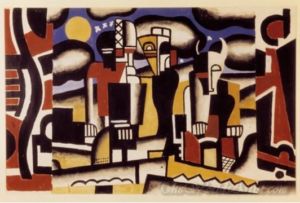
The ballet unfolds in five continuous sections, each depicting a stage of creation: chaos before the world’s beginning; the birth of plants and animals; the creation of man and woman; their awakening desire; and finally, a springtime scene of renewal, birth, and healing.
Perhaps the most obvious jazz transplant is the addition of the saxophone to the traditional orchestral complement. Its warbly voice infuses the music with an exoticism signaling that the Western world has been left behind. Throughout much of the work, a steady pulse, passed between the percussion, piano, and low strings, underlies the music, evoking the beat of a heart—the very essence of humanity.
Sinfonietta (1947)
Francis Poulenc (1899-1963)
Run Time: Approx. 28 minutes
Francis Poulenc was a late arrival to music. His father was a successful manufacturer who wanted his son to join the family business, barring him from entering conservatory training. He did study piano privately, and when his parents died, his piano teacher and mentor Richardo Viñes introduced him into the world of Paris’s burgeoning young musicians. Eventually, he joined up with a group of prominent composers that called themselves Les Six. Amongst his five compatriots was Darius Milhaud.
Poulenc was often dismissed by his contemporaries for writing music they viewed as “unserious,” that hewed too closely to the types of popular songs heard in saloons and burlesques. Poulenc, for his part, admitted to a love of what he referred to as the “adorable bad music,” owing, he said, to his mother’s affinity for it. Guilty pleasure though it may be, the infusion of this bubbly style gives his music a pleasing approachability. And if I may inject a personal observation: composers accused of unseriousness or kitsch are often guilty of nothing more than the power to write a really catchy tune.
I am, however, hesitant to describe this music as entirely unserious. The first movement is lush and earnest, with an intriguing combination of Broadway-esque flare, warm romanticism, and glassy Impressionistic textures colored by satisfying harp glissandos. The third movement, too, offers a gentle and contented Andante that employs the varied timbres of the wind section much like the impressionist painters deployed color.
Easy listening as it may be, the piece seems to capture the intrinsic spirit of the city—or at least our American view of it. It saunters by, effortless, unhurried, perhaps a little indulgent, and endlessly charming.
—Notes by Valerie Sly, 2026
A London Landscape: March 20 & 21
Overview
On the heels of our previous Masterworks concert highlighting some of America’s most definitive composers, A London Landscape of English composers in the modern era is a look now across the pond at their English counterparts. Many of the works on this program are contemporary to those from the previous concert, making this a unique opportunity to compare how orchestral writing developed in each nation during the modern era, particularly as they emerged from disruption of the world wars.
Just like the Americans, British composers turned to the natural world for solace and inspiration. Nature has always gone hand in hand with the development of positive national identity. How could it not? If we find hope and meaning in the natural world by going outside and, to borrow a phrase from the kids, touching grass, then the particular grass we touch is as intrinsic and fundamental to our identities as any other part of our culture. Just as the American landscape was reflected in the music on our previous program, here we encounter the exquisite character of the English countryside: fecund meadows, lush forests, crags and cliffs, and, of course, the perilous splendor of the sea.
Orb and Sceptre (1953)
William Walton (1902-1983)
Run time: Approx. 8 minutes
Orb and Sceptre, written by William Walton for the coronation of Queen Elizabeth II, is the successor to his earlier coronation march, Crown Imperial, composed in 1936 for the coronation of her father, George VI. For both works, Walton took their titles from a speech in Shakespeare’s Henry V, and he once remarked that he was reserving the phrase “bed majestical” for King Charles III, though he may never have imagined how many years it would be until the monarchy next changed hands. The speech reads as follows:
I am a king that find thee, and I know
‘Tis not the balm, the sceptre and the ball,
The sword, the mace, the crown imperial,
The intertissued robe of gold and pearl,
The farced title running ‘fore the king,
The throne he sits on, nor the tide of pomp
That beats upon the high shore of this world,
No, not all these, thrice-gorgeous ceremony,
Not all these, laid in bed majestical,
Can sleep so soundly as the wretched slave.
The orb and the sceptre are references to two key pieces of the Coronation Regalia, part of the Crown Jewels of the United Kingdom. The Sovereign’s Orb and the Sovereign’s Sceptre with Cross were both made in 1661 for the coronation of Charles II and used in every coronation since. The sceptre contains the largest colorless cut diamond in the world.
Orb and Sceptre was commissioned by the Arts Council of Great Britain, and Walton obtained permission to dedicate the piece to the Queen, a considerable honor, as such permission was rarely granted.
Musically, the piece is exactly what one would want in a coronation march. It’s celebratory, poised, and joyful, but never over-excited. The structure is straightforward, with a brisk opening, a stately middle section, and a return to a triumphant conclusion.
The Lark Ascending (1914)
Ralph Vaughan Williams (1872-1958)
Run time: Approx. 13 minutes
The Lark Ascending
By George Meredith
He rises and begins to round,
He drops the silver chain of sound,
Of many links without a break,
In chirrup, whistle, slur and shake.
For singing till his heaven fills,
‘Tis love of earth that he instils,
And ever winging up and up,
Our valley is his golden cup
And he the wine which overflows
to lift us with him as he goes.
Till lost on his aerial rings
In light, and then the fancy sings.
Ralph Vaughan Williams’s The Lark Ascending is a single-movement work for violin and orchestra, inspired by the poem of the same name by George Meredith. In his poem, Meredith describes the unique visual and auditory experience of a lark taking flight, while also capturing the sense of awe inspired by witnessing such a scene.
Larks, which are ubiquitous throughout the United Kingdom, possess one of the most unique songs of any bird. Their bright, high-pitched, fluttering sounds as they hover in the air like a helicopter, unlike most birds, which sing from a perch. Remarkably, they can continue for up to fifteen minutes seemingly without pause for breath. As Meredith wrote, they “drop the silver chain of sound, / Of many links without a break.” Sometimes they hover so high that they are almost invisible. For many, the skylark’s song is the quintessential sound of the English countryside.
In his lyrical interpretation of the poem, Vaughan Williams captures all the elements Meredith extolls: the lark’s song and flight, the beauty of the pastoral English landscape, and the well of emotion stirred in the observer of this small miracle of nature. The violin begins as the bird itself, rising from the earth and gradually ascending into its high register, where it hovers before descending again. Just like the lark, the violin plays extended passages without pause. Vaughan Williams captures it without resorting to mimicry, ebbing and flowing seamlessly between soaring lines evoking its majestic ascent, and fluttering passages that echo its song. Gradually, the scope of the music opens to include an English folk song, evoking a sense of place and reflecting the lark’s intrinsic connection to the English countryside.
Vaughan Williams wrote a great deal of music that we might call pastoral, and at a time when many of his contemporaries were becoming increasingly avant‑garde, he held true to more traditional styles. The music critic John Alexander Fuller Maitland remarked that when listening to his music, “one is never quite sure whether one is listening to something very old or very new.” Witnessing scenes of nature can evoke a similar suspension of time—the sense that what is happening now could have unfolded in exactly the same way a hundred years ago; that hearing a lark today is much the same experience as it was when Vaughan Williams heard one in 1914. The Lark Ascending captures something of that experience.
Symphony No. 104 in D major, “London” (1795)
Franz Joseph Haydn (1732-1809)
Run time: Approx. 28 minutes
By the late 1700s, Haydn, now in his 60s, was enjoying the rewards of a fruitful career. He had become quite well-known, and though his long-time patron, Prince Esterházy, had died, he had left Haydn a generous pension. The new prince was wholly uninterested in music, so the court musicians were dismissed, leaving Haydn with fame, money, and quite a lot of free time.
Requests for commissions were coming in left and right, but the most interesting was an offer from conductor and music impresario Johann Peter Salomon, for not one, but twelve symphonies. Salomon was a significant player in various European music scenes. He was born in not just the same city as Beethoven (Bonn), but the same house! It’s also believed that he provided Haydn with the original model text used for The Creation, as well as bestowed the nickname “Jupiter” onto Mozart’s 41st symphony.
Haydn accepted the offer and set out for London, where he composed most of the works, and oversaw their premieres. The public adored him, and his time in the English capital was both well received and well compensated. In his journal he wrote that he made 4,000 gulden from the concert, saying, “such a thing is possible only in England.”
Though all twelve symphonies are collectively known as the “London Symphonies” (sometimes also called the “Salomon Symphonies”), Symphony No. 104 is the only one that today bears the official subtitle London, possibly because it is the final installment of the set and was used for the grand celebratory concert honoring Haydn’s time in the city. It’s unclear whether he knew this would be the last symphony he ever composed, but he certainly knew this was his grand adieu to London. He delivered a farewell for the ages.
Symphony No. 104 exudes the spirit of a composer who has made his mark and has nothing remaining to prove. It also joyfully capitalizes on the fact that London orchestras were larger than the troupes Haydn was used to writing for as a court composer. The piece is dramatic and experimental, full of exuberance, and most of all, shows off one of the things Haydn was best at—the element of surprise.
It begins with a big, dramatic opening, the orchestra playing declarative chords in unison, alternating with a more somber passage. Haydn writes a substantial introduction in this manner, long enough to convince even the most seasoned concert-goer that this will be a dark and angsty work. But just as you think you’ve got it pinned down, the music gives way to an easy going melody. Fooled you. And before there’s even time to finish a second phrase, it erupts into a triumphant, full-throated statement of the theme. Fooled you again. Here we have finally arrived at the true character of the first movement—lively, proud, and absolutely victorious. The crowd must have been delighted.
The second movement adagio is delicate, courtly, sweet, and unassuming, until—I almost feel a spoiler alert is warranted—the orchestra suddenly explodes in a great rapture. Where did this come from? It’s reminiscent of the fiery, thunderous passages of sacred oratorio; one almost expects a 300-piece chorus to appear. Then, just as quickly as it began, everything stops, and the music goes right back to its charming dance, like nothing ever happened, but only for a moment before another burst of energy takes hold. He got you again.
I won’t spoil every unexpected twist and turn, but the roller coaster ride continues all the way to the end. The exuberant third movement would be incomplete without a few unexpected halts, and the joyous finale meanders from its whirl once or twice to offer some rather poignant asides, echoing the disquiet of the work’s opening.
All of this points to a man who, nearing the end of a prolific career and having earned the full trust of his audience, was simply taking a victory lap. It also lays a trail of breadcrumbs that we can follow directly to Beethoven, who was profoundly influenced by the great composer. Consider all those Beethoven slow movements suddenly interrupted by an opening of the heavens—a strike of Zeus’s thunderbolt. One can imagine Haydn looking down from his eternal rest and saying, “He got that from me.”
Four Sea Interludes from Peter Grimes (1945)
Benjamin Britten (1913-1976)
Run time: Approx. 16 minutes
In the east of Suffolk, along the North Sea and some 87 miles from London, lies the small fishing village of Aldeburgh. Home to approximately 2,200 people—a population that has remained largely unchanged since the postwar years—the village is widely accepted as the setting for Benjamin Britten’s opera Peter Grimes. It was also home to Britten himself, as well as to George Crabbe, the 18th-century author of The Borough, the poem on which Benjamin Britten based his tale. Britten settled in Aldeburgh shortly after completing Peter Grimes. He first encountered Crabbe’s poem whilst feeling rather homesick in America during World War II, and later recalled that upon reading it, “In a flash I realised two things: that I must write an opera, and where I belonged.”
Peter Grimes is, at its heart, a story about otherness and the danger that can arise from fearing what we don’t understand. Peter is a fisherman whose volatile temper and antisocial ways have made him an outcast in his community. When his apprentice dies from harsh conditions at sea, he is put on trial, and the townspeople grow increasingly suspicious, eventually hunting him down in an angry mob and driving him to commit suicide by sinking his ship in the ocean.
Britten himself knew a thing or two about being an outsider. He was a gay man at a time when homosexuality was illegal in England. Though his relationship with well-known tenor Peter Pears was something of an open secret amongst their artistic community, and the pair performed together extensively, they could never speak publicly of their relationship. The couple was together from 1939 until Britten’s death in 1976, but only nine of their 37 years together were spent legally. Britten was also a staunch pacifist. He and Pears officially registered as conscientious objectors during the war, a decision that was not altogether applauded by the British public.
Peter Grimes has essentially four principal characters. There is Peter, who wishes to be accepted by his community but cannot amend his volatile nature nor his isolationist tendencies. There is Ellen Orford, the schoolteacher whom Peter hopes to marry and the only member of the village who is sympathetic to him. There are the townspeople, whose fear of Peter leads to blame and hysteria. And then there is the sea itself.
In the opera, the sea is portrayed by the orchestra, which plays a series of interludes that Britten cleverly composed to cover scene changes, allowing time for the sets to shift while musically establishing the tone of each new day. Britten fashioned four of these interludes into the orchestral suite, offering short vignettes that encapsulate the turbulent story even without the text and actors.
In addition to providing an omnipresent and malevolent backdrop, the sea offers a metaphor for Peter himself—both his inner turmoil and his contradictory character. In the words of Peter Pears, who originated the character, Grimes is “neither a hero nor a villain,” but “an ordinary, weak person who, being at odds with the society in which he finds himself, tries to overcome it and, in doing so, offends against the conventional code, is classed by society as a criminal, and destroyed as such. There are plenty of Grimeses around still, I think!”
Just as people often contain contradictions, the sea has many conflicting characters: tranquility, violence, beauty, abundance, power. And like the inexorable resolve of the angry mob that ultimately seals Peter’s fate, a tide, when it has gathered enough force, can rarely be overcome.
—Notes by Valerie Sly, 2026
Of Passion & Promise: February 20 & 21
Overview
For better or worse, the orchestra and orchestral music are fundamentally European inventions. Symphonic practice and styles were developed over hundreds of years in Western Europe where audiences were well educated in musical practice and held strong, often rigid opinions about what was acceptable and what was not. When symphonic music spread to Eastern Europe and eventually to the United States, it brought with it those well developed practices. But over time, freed from centuries of expectation, it was allowed to absorb new influences, mingle with emerging cultural identities, and gradually evolve into something distinct from its European parentage.
American composers were not the only ones to benefit from a more open-minded audience. The late nineteenth and early twentieth centuries brought a kind of artistic Russian invasion to the United States. Composers such as Tchaikovsky, Stravinsky, Prokofiev, Shostakovich, and Rachmaninoff all spent significant time in the United States, often finding American audiences more receptive to their music than those in Western Europe. In fact, Americans loved the Russian sound, favoring its lush romanticism and emotional depth. That affinity has endured. These composers played a major role in shaping the sound of early film music, writing some of the earliest film scores, and leaving a lasting mark on what we now recognize as the cinematic sound.
Two American composers who played central roles in shaping the American symphonic sound were Aaron Copland and Leonard Bernstein. Copland’s distinctive voice came to define what we now think of as Americana through works such as Appalachian Spring and Rodeo, while Bernstein’s influence—both as a composer and as a conductor—profoundly shaped the American orchestra, and bridged the worlds of classical music and popular idioms. For Russian music, one of the earliest works to capture American audiences and establish a lasting appetite for that repertoire was Tchaikovsky’s Piano Concerto No. 1.
There’s more to the story than just these three composers, of course, but this concert offers a glimpse at how the apple fell from the tree, tracing symphonic music in America from around 1875, when Tchaikovsky and other Russian composers first made their mark on American audiences, to the 1950s, by which time American orchestral music had arrived at a voice entirely its own.
Overture to Candide (1956)
Leonard Bernstein (1918-1990)
Run Time: Approx. 5 minutes
Leonard Bernstein’s Candide somewhat defies categorization. Most often labeled an operetta, it is lighter fare for the opera stage, yet more classically rooted than a Broadway musical. Its roles, like heroine Cunégonde, have been played by both soprano Renée Fleming and Broadway star Kristin Chenoweth. How, then, to categorize it? Perhaps the ambiguity is part of its charm, and apt for a composer who so deftly straddled the worlds of classical music stardom and popular culture.
The story comes from Voltaire’s 1759 satire which savagely rebukes the philosophy of blind optimism. The idea—popularized by Leibniz and touted throughout the play by Candide’s tutor, Dr. Pangloss—insists that we live in “the best of all possible worlds” and therefore everything that happens, no matter how horrific, must be for the best. Candide earnestly tries to take this to heart, but over the course of the story he faces all manner of evils, including war, greed, earthquakes, shipwrecks, and even slavery, all while Pangloss tirelessly explains why each humiliation was necessary. Voltaire’s point is merciless: abstract optimism is grotesque in the face of real human suffering.
It is not hard to see why this story resonated with Bernstein. For a Jewish man barely ten years after the end of World War II, the idea of human cruelty made acceptable by ideology, prejudice, and willful blindness was no abstraction. Candide is not the only of Bernstein’s works to grapple with themes of violence and hatred, but where works like West Side Story and Mass face them with solemnity, Candide approaches them with manic absurdity.
Bernstein’s music meets Voltaire’s barbed satire pound for pound, and the overture offers an excellent snapshot of the antics to come. There’s something quixotic about the music’s exuberance: bright, brash confidence offset by chirping woodwinds, strange percussion sounds, and an undercurrent of insidious mockery. Even the radiant love theme between Candide and Cunégonde feels deliberately exaggerated—valiance teetering on parody.
And yet, at the conclusion of the story, Bernstein allows himself a measure of sentimentality that Voltaire does not. Both endings find the characters disillusioned and withdrawn from the world, settling on a small farm to live a simple, practical life. But where Voltaire’s final line is curt and unsentimental—“il faut cultiver notre jardin” (“we must cultivate our garden”)—Bernstein, ever the humanist, transforms this resignation into a warm and hopeful call, set to one of the loveliest ensemble pieces in the repertoire, “Make Our Garden Grow.” Just try to get through it dry-eyed. Candide is a fairytale indeed, but not one about happy endings. It’s a fairy tale about how to live in a world of injustice and horror and build something anyway.
Piano Concerto No. 1 (1875)
Pyotr Ilyich Tchaikovsky (1840-1893)
Run Time: Approx. 38 minutes
American audiences love Tchaikovsky. There’s something about his particular brand of Romanticism, with its soul‑bearing directness and obvious melancholy that just speaks to us. The love affair all began with his First Piano Concerto, the work that introduced the composer to U.S. audiences and went on to have a rich history in this country. It was premiered by Hans von Bülow and the Boston Symphony on October 25, 1875, after being initially rejected by Nikolai Rubinstein, who deemed it poorly written and unplayable. The audience rather disagreed with Rubinstein. They went wild for the work, welcoming Tchaikovsky immediately, and never looking back.
Just 16 years later, Tchaikovsky himself conducted the work for the opening of Carnegie Hall in 1891, and in 1958, the concerto took on a new kind of cultural significance when Van Cliburn, an American, won the first International Tchaikovsky Competition performing it. Upon his return to the United States, Cliburn became a national figure—an American winning a Russian competition during the Cold War was something of a coup—and his recording of the concerto was the first classical album ever to go platinum. Today, it remains one of the most performed piano concertos in the world, ranking as the fourth most frequently performed piano concerto at Carnegie Hall, according to their website.
It’s easy to see why this concerto was met with such enthusiasm. Filled with dazzling virtuosity, powerful chords, and captivating melodies, it demonstrates both the excitement and virtuosity of a great piano concerto as well as Tchaikovsky himself at his very best.
Symphony No. 3 (1946)
Aaron Copland (1900-1990)
Run Time: Approx. 42 minutes
To today’s ears, there is no composer that more readily personifies the American symphonic sound than Aaron Copland. From Fanfare for the Common Man to Appalachian Spring, his sensibility seems to capture something intrinsic about the United States, from its spirit to its diverse landscapes. But what is it about his music that sounds so American? Is it just that we’ve come to associate it with Americana because of the many patriotic, military, and western films that have so effectively utilized his music? Or is there really something about it that speaks specifically to this land?
It’s easy to forget that barely a century ago, the United States was still unsure of its artistic identity. The country was still young, and its artistic life was still largely shaped by European imports, while the traditions of Native peoples and other non-European cultures were overlooked. As Jeff Counts has written, “Much like the search for the Great American Novel, the Great American Symphony was an aspirational mid-century dream for a country that longed to compete credibly with the Old World.”
Copland himself explored many different styles and voices throughout his career. Raised in Brooklyn, New York, the son of Jewish immigrants, his formative musical studies took him to Paris where he studied with renowned composition teacher Nadia Boulenger. Later, he traveled extensively throughout America, Africa, and Mexico, where he formed an important friendship with composer Carlos Chávez. He experimented with various genres, moving from avant-garde compositions to an appreciation for the music of the American Southwest and Mexico. Late in his life he delved into serialism, a modernist technique that rethinks the treatment of pitches entirely. But the works for which he is most beloved are the ones hailing from his middle period, where his personal style culminated in the sound perhaps best personified by the 3rd symphony: Americana.
If you Google the characteristics of Copland’s Americana period, the words you’ll most often find are things like “open,” “broad,” and “simple.” Though these words may seem metaphorical, they actually do reflect real musical traits Copland used to create his sound. The types of intervals he favored, fourths and fifths, are less definitive than the usual building blocks of the Western canon. They do not have major or minor qualities; you need 3rds for that. In the absence of this defining quality, they have a sense of possibility. There are fewer rules governing how they might function harmonically. They can be anything. What an impeccable allegory for the American dream. And the harmonies, uncomplicated and widely spaced, give such a sense of scale as to evoke a great expanse. How could we not see this as the perfect backdrop for a scene depicting the Great Plains or the Mountain West?
Besides the pure musical qualities, Copland is not withholding in his titles, particularly when it comes to music of this period. Rodeo; Billy the Kid; Fanfare for the Common Man—these are American stories, and he’s made sure we know it.
The Third Symphony is built from precisely these qualities, but don’t take openness and simplicity to indicate a lack of drama. The first movement offers all the might, and perhaps menace, a brass section can muster, before yielding to an austere lullaby in the strings and winds. If the first movement evokes the natural world, the second is much more urban—bustling even, featuring shorter spurts of melody that buzz hurriedly around the orchestra like a busy cosmopolitan scene. Here, the influence of jazz as well as the avant-garde contemporaries like Stravinsky can really be heard in the snappy articulations and syncopated rhythms.
The lush, but angst-filled third movement offers a sharp turn from the excitement, reminding us that this work was premiered just one year after the close of World War II. But halfway through the movement, Copland revisits material from the second, perhaps nodding to the persistence of the human spirit.
In the transition from the third to the fourth movement, Copland arrives at perhaps his most salient point. Here he inserts the Fanfare for the Common Man—written just 3 years prior in fulfillment of a commission for uplifting and patriotic music to bolster the war effort—in its entirety, before continuing with his joyously hopeful conclusion.
If readers will indulge a bit of a leap: the placement of the Fanfare for the Common Man in this symphony reminds me very much of the “Ode to Joy” from Beethoven’s 9th—a defining melody placed late in the work and carrying with it a philosophical message. If Serge Koussevitzky, who commissioned the work for the Boston Symphony Orchestra, was indeed searching for the “Great American Symphony,” he certainly got it. And if Beethoven’s Ninth serves as a totem for European artistic and philosophical achievement, then one might make the case that Copland’s Third Symphony occupies a similar symbolic space for American music, offering a message of hope and forward looking optimism for the country amidst a time of darkness.
Finally, because it’s too wonderful a full-circle conclusion to resist, I’ll end with a bit of trivia: this work received its European premiere in 1947, conducted by none other than Leonard Bernstein leading the Czech Philharmonic.
—Notes by Valerie Sly, 2026
The Farewell Symphony: January 22, 2026
Symphony in B minor, “Unfinished” (1822)
Franz Schubert (1797-1828)
Run time: Approx. 26 minutes
The mystery surrounding Schubert’s “Unfinished” Symphony has frustrated scholars since the work’s premiere. The first and most obvious question—where is the rest of it?—has never been definitively answered. Did he try to write more and then abandon it? If so, why? Did the onset of his health problems have something to do with it? He likely began noticing symptoms of the illness that would eventually kill him around this time. Or maybe he simply got distracted and moved on to other material.
These questions are unlikely to be answered with any certainty, but perhaps that’s for the best. The music itself teems with an uncertainty that feels perfectly suited to this backdrop. Right from the opening bars, the minor theme played in the low strings, followed by a trembling melody in the violins, creates an air of unease that plagues the entire first movement, no matter how hard it tries to find solid footing. Even the second movement, whose main theme unfolds as a stately, reverent chorale, cannot help but slip back into the minor from time to time. Its yearning middle section, ushered in by a poignant clarinet solo, brings flashes of Beethovenian drama: those sudden, striking thunderbolts that break through the otherwise tender moments.
Discovery:
In 1822, Schubert gave the manuscript of the two completed movements to his friend Anselm Hüttenbrenner as a gift, thanking him for helping secure a membership in an Austrian musical society. This was an important step for a composer who was largely unknown during his lifetime and often struggled to get his music performed. After that, we can only assume the work sat in a drawer gathering dust. There’s no further mention of the symphony by Schubert, Hüttenbrenner, or anyone else. Oddly, Schubert seems not even to have mentioned it to his other friends.
When Hüttenbrenner finally brought the work to light decades later, Schubert had long been dead, but his music was beginning to gain widespread recognition. In 1865, Hüttenbrenner showed the manuscript to conductor Johann von Herbeck, who organized its long-delayed premiere. Why Hüttenbrenner waited nearly 40 years to share it remains another mystery. When he finally did, rumors of an unfinished B‑minor symphony were already circulating. Perhaps he had simply wanted to keep a piece of his friend—gone far too soon—for himself.
Possible additional movements:
Amongst Schubert’s belongings, scholars discovered the outline of a third movement Scherzo that has been definitively linked to this symphony. He did begin orchestrating it, but only managed to complete a few bars.
Some have posited that Schubert’s Entr’acte to the play Rosamunde, one of the only other works he wrote in the key of B-minor, may have been repurposed from music originally intended to be a Finale to the “Unfinished” Symphony, though this is highly contested.
Schubert’s mature style:
In addition to the former questions concerning the work’s history, there’s one more to consider: why are we so bothered that Schubert didn’t finish it? Surely artists abandon works all the time. Schubert himself left one or two other symphonies incomplete, yet we rarely dwell on those. So what is it about this one that keeps drawing us in?
Think for a moment of van Gogh’s Starry Night, a work that helped solidify the painter’s mature style. Imagine if he had abandoned it when it was nearly complete—the sketch done, the initial layers in place, almost realized. That’s what we have of Schubert’s “Unfinished” Symphony: two movements complete, a third waiting for its colors to be filled in. It’s within reach of something truly remarkable, and it’s cited more than any other work as the beginning of his mature compositional period. After this, he would go on to produce everything he’s most famous for, including his monumental genre-defining song cycles like Winterreise and Die schöne Müllerin, and, of course, his 9th and final symphony, “the Great.” And what we do have of the 8th Symphony is substantial: the first two movements alone last 26 minutes, hinting at a work of epic scale, echoing the might of romantic Beethoven. That such a creation was left incomplete remains an irresistible conundrum.
A life unfinished:
Schubert died at just 31, likely of syphilis, which plagued him for eight years—one of the most tragic early deaths in music. In that short life he produced a prolific body of work, largely defining 19th-century German art-song and song cycle, penning over 600 Lieder, numerous string quartets, and nine symphonies. With such a catalog, it’s impossible not to wonder what he might have done had he lived longer. Perhaps that’s part of the allure of the “Unfinished”: it feels like an allegory for Schubert himself—startlingly brilliant, poignantly expressive, and ultimately over far too soon.
Symphony No. 45 in F-sharp minor, “Farewell”(1772)
Franz Joseph Haydn (1732-1809)
Run Time: Approx. 27 minutes
The story of Haydn’s “Farewell” Symphony is one of the most charming in classical music, and, somewhat unusually, it is verifiable—the composer himself later recounted the work’s origins to his biographers.
It goes like this: Haydn served as Kappelmeister for the Esterházy court, a job title that essentially made him composer-in-residence, orchestra conductor, occasional violinist, and orchestra personnel manager. The Esterházy party had been staying at one of the Prince’s favorite country residences, located far from the musicians’ families. What was intended to be a temporary stay dragged on longer than expected, and the orchestra grew increasingly unhappy. Eventually, the musicians appealed to Haydn for help. But, this being pre–French Revolution Europe, Haydn could not simply approach the Prince and lodge a complaint. So, he devised a plan to put the grievance into music instead.
What he created is one of the most unusual endings in the symphonic repertoire. At the conclusion of a fiery final movement, the music unexpectedly subsides into a calm, extended coda, during which, the musicians were instructed to stand and quietly leave the stage one by one, until only two violins remained to finish the symphony.
What makes this story especially satisfying is that it worked! According to Haydn, Prince Esterházy remarked to him after the performance that he understood the message, and that they would depart the following day.
The famous theatrical ending is certainly the most affecting part of the work, but it doesn’t come out of nowhere. Haydn sets it up with a number of other oddities, leaving breadcrumbs throughout the symphony that would have raised eyebrows in the audience, and perhaps primed the message’s intended recipient to listen more closely.
The first of these clues is the work’s key. F-sharp minor was an extraordinary choice in the 18th century, so unusual that Haydn had to commission special horn crooks from the Esterháza blacksmith in order for the horns to play in it at all. At the time, horns and trumpets lacked valves and could only play in specific keys by adding different lengths of tubing, called crooks. Why go to such trouble? Perhaps to announce that this would not be just an ordinary symphony.
From the outset, the work is undeniably dramatic. The opening material is driven by an urgent, pulsing accompaniment in the violas reminiscent of trotting horse hooves—a nod to the journey the musicians so earnestly desired. Throughout the work, there is a pervasive sense of melancholy and longing that sets it apart from the more conventional symphonies of the period.
The Minuet, too, is just a bit strange. It starts lightly, almost cute, but then introduces chords that are strikingly dissonant. One might momentarily wonder if someone played a wrong note, if the effect didn’t recur. Then, a sudden outburst of dramatic and turbulent minor-key material further disrupts the expected courtly dance. An audience accustomed to the typically lighter symphony of the time must have been jarred to say the least. And the Prince, who was well versed in music, would surely have been wondering what on earth Haydn was up to.
Imagine, then, how stirring the scene must have been—a nighttime concert near the water, the musicians one-by-one snuffing out their candles as they quietly left the stage. While modern orchestras are rarely able to recreate that unique atmosphere—the unavoidable consequence of modern fire codes—the evocative and poignant ending makes this work a fan favorite, and a unique testament to the power of music to change minds. —Notes by Valerie Sly, 2026
Luminous Legends: Tchaikovsky & Brahms: January 30 & 31, 2026
Egmont Overture (1810)
Ludwig van Beethoven (1770-1827)
Run Time: Approx. 8 minutes
In the years following the French Revolution, Beethoven was a great admirer of Napoleon Bonaparte. He saw him—as many did at first—as a self-made revolutionary who would bring democracy to Europe. On the cusp of the Napoleonic Wars, Beethoven was completing his third symphony, which he had reverently inscribed with the subtitle “Intitolata Bonaparte.” The story goes that when, in 1804, Beethoven learned that Napoleon had declared himself Emperor of France, the composer flew into a fit of rage, violently scratching “Bonaparte” from the top of his manuscript, and replacing it with the word “Eroica” or “Heroic.” “Now he, too, will tread underfoot all the rights of man,” he declared, and “indulge only his ambition; now he will think himself superior to all men [and] become a tyrant!”
Unfortunately, Beethoven’s original biographers Anton Schindler and Ferdinand Ries were somewhat prone to exaggeration. We can never know if this is what truly happened, although the surviving manuscript certainly bears the evidence of one very scratched out “Bonaparte.” What we do know is that Beethoven was strongly inclined toward democratic ideas, once writing, “To do good whenever one can, to love liberty above all else, never to deny the truth, even though it be before the throne.”
Beethoven was right to be upset; Napoleon spent the next decade invading all over Europe, including twice in his home of Austria. The 1809 attack on Vienna forced the composer to evacuate, sending him to his brother for refuge, where he spent much of the event with pillows over his ears desperately trying to protect what little remained of his hearing.
Just a few months later, Beethoven was approached to compose the incidental music for a play by Johann Wolfgang von Goethe about the heroic life of Lamoral, count of Egmont from the Low Countries (now known as the Netherlands,) who takes a valiant stand against oppression, laying down his life in the name of liberty. It must have been a no-brainer.
With his overture, Beethoven provides a perfect preparation for Goethe’s politically charged tale. The heavy weight of oppression bears down on the orchestra as it sounds the opening chords—plodding and constrained, the music is wrenched out as if shackled. Sighing figures in the woodwinds impart a sense of lament. When the main theme begins, it’s tentative at first, just the spark of an idea—the faint suggestion that a better world may be possible. Gradually, it gathers energy and strength, becoming a force to be reckoned with, until, in a burst of joy and triumph, it resolves from the minor key in which it began to the major. Now, the plodding figures from the opening have transformed into stately declarations, and a flurry of strings whip the orchestra into an exhilarating and victorious ending.
The work has become symbolic of populist movements all over the world, even serving as an unofficial anthem of the Hungarian Revolution of 1956. Valiant brass fanfares proclaim Enlightenment ideals to be victorious above all else. As Patrick Henry put it just 20 years earlier, and half a world away, “Give me liberty or give me death.”
Orchestral Suite No. 4, “Mozartiana” (1887)
Pyotr Ilyich Tchaikovsky (1840-1893)
Run Time: Approx. 26 minutes
In his own program note for the premiere of Mozartiana, Tchaikovsky wrote: “A great many of Mozart’s short pieces are, for some incomprehensible reason, little known — not only to the public but to musicians as well. The author who has arranged this suite, entitled ‘Mozartiana,’ had in mind to provide a new occasion for the more frequent performance of these pearls of musical art, unpretentious in form, but filled with unrivaled beauties.”
The practice of reworking, re-orchestrating, or otherwise tinkering with the works of fellow composers has existed for as long as music has been written. Sometimes, a reworking bears the stamp of someone who clearly thought he could do it better than the original. That is decidedly not the case here. This reimagining of Mozart’s music is carried out with unmistakable love and reverence, as one would only expect for the composer Tchaikovsky referred to as “my god, Mozart.”
Over the course of the set, Tchaikovsky grows increasingly bold with his interpretations, his own voice appearing more and more as the movements progress. The first two movements are based on two short dance forms: the Gigue in G Major, K 574—which Mozart left inscribed in the guest book of an organist he was visiting in Leipzig—and the Minuet in D major, K 355. Both of these works are sweet on the surface, but they are strikingly ahead of their time, full of bold dissonances that Tchaikovsky eagerly highlights in his orchestration. Here, he remains quite faithful to Mozart’s originals, even scoring them in a manner that could pass for a Classical-era orchestration.
The third movement is based on Mozart’s Ave verum corpus, K 618, originally written for string orchestra and chorus. But for his version, Tchaikovsky turned to an organ arrangement by Franz Liszt. Here, Tchaikovsky begins to loosen his restraints a bit, and this is the first movement of the set that sounds more like Tchaikovsky than Mozart—especially with the use of the harp. The music takes on that unmistakable balletic, almost fairytale quality that Tchaikovsky does so well.
The fourth and final movement is based on a Mozart work that is itself already a reworking of another composer: 10 Variations on the Arietta ‘Unser dummer Pöbel meint’ by Christoph Willibald Gluck. Though Tchaikovsky does not add any new variations of his own, he fully transforms Mozart’s music into the world of the late-Romantic Russian orchestra. By this point, we are entirely within Tchaikovsky’s sound world, complete with grand trumpet fanfares, warmly singing violin solos, and densely layered orchestral textures.
As one final note, Tchaikovsky’s orchestration features the clarinet in a prominent soloistic role, which in itself offers a small nod to Mozart, who loved the instrument and played a significant role in securing its permanent place in the orchestra.
Symphony 3 in F Major, Op. 90 (1883)
Johannes Brahms (1833-1897)
Run Time: Approx. 38 minutes
Johannes Brahms is a somewhat elusive character in music history. He was intensely private about his inner world, burning many personal correspondences, destroying works with which he was not satisfied, and eradicating all evidence of his compositional process. He never married, but he did have a tight-knit circle of friends with whom he shared his life; what we know of the enigmatic composer comes largely from their memories and from letters that did survive. Besides that, we have his music. So, in cases like the Third Symphony, those of us who analyze music get to engage in a fascinating combination of detective work and armchair psychoanalysis. At times, it can feel a bit overreaching, but in a letter to one such friend, Brahms did say, “I speak through my music.” Very well, I will take that as an invitation.
In the summer of 1883, Brahms took up lodging in Wiesbaden, a picturesque city along the Rhine River—not his usual workplace. The Rhine, whose myth-inspiring drama bisects Western Europe from the Alps to the North Sea, had long served as a muse for German artists, and Brahms, always finding inspiration in nature, was no exception. Earlier that spring, he had turned 50, a milestone to be sure, no matter the era. The work is, in my view, one of deep introspection and nostalgia, sprinkled with references to the most important characters in his life, and anchored upon two main ideas. One is the Rhine, which is depicted throughout the work. The other is the musical cryptogram F–A–F, the three notes upon which the entire work is built, and a nod to two of his dearest friends, violinist Joseph Joachim, and composer Robert Schumann.
Thirty years earlier, the up-and-coming young Brahms was introduced to Robert and Clara Schumann by violin superstar Joseph Joachim. The Schumanns were about as close as one could get to a 19th-century musical power couple, with Clara herself an internationally renowned pianist. They immediately recognized the young man’s talent and took him under their wing, inviting him to stay with them in their home in Düsseldorf—another city on the Rhine.
During this time, Robert Schumann organized a collaborative sonata written jointly by himself, Brahms, and another friend Albert Dietrich. Conceived as a gift for Joachim, the sonata was based on the notes F–A–E after Joachim’s personal credo, “Frei aber einsam” (“Free but lonely”). The young Joachim believed that the artist must eschew all attachments in order to properly fulfill his purpose as an artist.
Brahms, for his part, agreed with this notion of the unfettered artist, but felt that this independence led not to isolation, but to fulfillment. As a response, he took on his own motto, “Frei aber froh” (“Free but happy”), which he outlined with the notes F–A–F, which appears in scattered works throughout his life.
Robert Schumann’s mentorship was very meaningful to Brahms, but unfortunately it was cut short by the former’s fraught mental health. Just two years after they met, Robert attempted suicide by jumping into the Rhine. Although he was rescued by fishermen, he never recovered from his breakdown and voluntarily entered an asylum, where he died in 1856. After Robert’s death, Brahms and Clara remained extremely close, her daughter later recalling that it seemed he was always part of the family. Their letters reveal a deep love for each other, but by all accounts they kept their relationship platonic. Many pages could be written about Brahms and Clara Schumann, but that’s a story for another time.
One last figure whose fingerprints can be found throughout the Third Symphony is Richard Wagner. Wagner and Brahms were not well acquainted, but Brahms’s career was largely defined by him—or perhaps more accurately, against him. Music critics had declared a rift in compositional aesthetics that we now affectionately call the “War of the Romantics,” which pitted the progressive Wagner against Brahms’s more conservative tastes. This wasn’t just a theoretical schism; critics and fans who fell into Wagner’s camp would regularly show up to Brahms’s premiers just to boo. But despite their differences, Brahms had great respect for Wagner’s talent, and even possessed a piece of the original manuscript for his opera, Tannhäuser. Wagner, too, has intrinsic ties to the Rhine, having set his monumental Ring Cycle on its waters. In February 1883, just a few months before Brahms arrived in Wiesbaden, Wagner died.
So, what does any of this have to do with the Third Symphony?
The very opening chords of the symphony present Brahms’s signature F–A–F theme, the striking three-note idiom that stretches dramatically skyward as it reaches from the lower F to the upper octave. This figure serves as the primary theme of the first movement, but it is not confined there. It returns throughout the symphony and reemerges in a particularly powerful way at the close of the final movement. Here, Brahms has slightly altered the notes of his credo to F–A-flat–F, which changes the figure from major into minor, and presents one of the principal conflicts of the work: the dichotomy between major and minor. Throughout the piece, the music slips between the two constantly, never able to stay rooted in one for long. Could this struggle between darkness and light, particularly where it colors this extra-musical theme, reveal complex feelings around his chosen life of freedom?
Coming directly out of the opening F–A–F chords, the strings play a descending passage that bears a striking resemblance to the opening of Robert Schumann’s Third Symphony, known as the Rhenish—Rhenish, of course, referring to the Rhine. Next, as the energy begins to lull, Brahms adds a direct quote from Wagner: the siren song from Tannhäuser. It’s even been suggested that the easy, folk-like clarinet solo that follows these chords sounds an awful lot like Liszt’s song “Die Lorelei”, based on the Heine poem about the famous siren of the Rhine. Beneath it all, a constant motion in the accompanying instruments seems almost irresistibly to suggest the rush of water.
With the inclusion of these references, it’s difficult not to wonder if Brahms might have been reflecting on several touchstones in his life—the friendships of his youth, the loss of his mentor, his inescapable rivalry with Wagner, and perhaps above all, his choice to remain alone—all somehow subtly linked to the majestic river on which he now stayed.
The second movement is more tender, but retains that distinctive flow, reminding us that we haven’t strayed far from the water. Clara Schumann described the movement as “pure idyll; I can see the worshipers kneeling about the little forest shrine, I hear the babbling brook and the buzz of insects.” Indeed, there’s a sense of reverence—almost liturgical—in some of the chords, particularly in the movement’s final moments.
The third movement seizes on the C-major chord that concludes the second movement, only to immediately transform it into C-minor, reinforcing the symphony’s central tension between the two. On the surface, it presents as a somber waltz, but the main melody rises and falls with a sweeping motion that swells and ebbs like waves breaking against the shore, perhaps presenting a glimpse of the darker, more dangerous potential of the Rhine.
The symphony’s conclusion begins where the first movement started: in F-minor, presenting an uncertain, agitated, and rhythmically intense version of the F–A–F theme before shifting back to the major. Much of the movement alternates between these two, but in the end, major triumphs as the final iterations of F–A–F, played first in the solo horn, then the strings, are transposed up to a different part of the scale, allowing the theme to fit into the F-major chord—cleverly done! From there, the work closes in quiet reverence, swelling into a final echo of Schumann’s Rhenish theme, the strings oscillating in gently flowing passages beneath tranquil chords in the winds.
Many analyses of this work get caught up in the F–A–F theme, which is understandable; it’s significant, and musical ciphers are undeniably exciting. But I believe the true heart of this symphony is the Rhine. In my view, this is Brahms’s Rhenish Symphony, but it’s not the idyllic fairytale Rhine of Schumann, nor the Gods and Monsters world of Wagner. This is the Rhine of Brahms’s inner world, the vein connecting the pillars of his life: love, loss, solitude, friendship, and above all, art. Or maybe none of that is true. Maybe it’s just a symphony in F-major. As was Brahms’s way, he’s left it up to us to decide.
—Notes by Valerie Sly, 2025
Messiah (1742) | Composed by George Frideric Handel (1685–1759)
King of kings,
And Lord of lords,
And He shall reign forever and ever,
Hallelujah! Hallelujah!
The holiday season wouldn’t be complete without some timeless traditions, and few are as enduring as Handel’s Messiah. Whether you’ve attended every year to hear the ASO perform this holiday classic or you’re experiencing the grand spectacle for the very first time, we’re confident you already know this work. You’ve almost certainly sung along to parts of it! After all, the “Hallelujah” Chorus is among the most recognizable works of art in history, right alongside the Mona Lisa or Michelangelo’s David. It’s credited in over 500 films! So today, we’re not here to introduce this piece—you’ve met before. Instead, we offer a bit of insight into how this unforgettable work was created, the composer behind it, and how it became such a lasting part of the Christmas season.
Who was George Friedrich Handel?
Handel composed some of the most well-known music of the Baroque era, but the sheer fame of his works has somewhat overshadowed the man himself. Today, he’s less of a household name than Bach or Vivaldi, although his music remains widely recognized. Handel was actually born in the same year as Bach—1685—in Germany, but he led a much more international life. He spent his childhood in Hamburg but received much of his musical training in Italy before establishing his career in London. He eventually became a naturalized British citizen and is often considered more an English composer than a German one.
After settling in London, Handel became a favored composer of the British crown, creating a great deal of ceremonial music for royal events. You may know works like Water Music, composed for King George I and performed by musicians floating in boats on the River Thames. Handel produced many pieces for such celebrations and, as a result, gained significant popularity and fame during his lifetime—a rare achievement for any artist.
What type of music did he compose?
Handel is renowned for three main achievements: his music for grand public celebrations (such as Water Music or The Arrival of the Queen of Sheba), his monumental oratorios like Messiah, and his highly successful operas. All of these share a sense of spectacle, something Handel was particularly skilled at creating. He had an exceptional instinct for drama and impact; as Mozart observed, “Handel understands effect better than any of us—when he chooses, he strikes like a thunderbolt.”
How did Messiah come about?
In the years before composing Messiah, Handel mainly focused on composing Italian opera, which for decades was considered the highest form of musical art in Europe. But by the 1740s, opera started to fall out of fashion. It was very costly to produce (as it still is), and aristocratic support was decreasing. So, Handel decided to shift his focus to music that could be enjoyed by the general public.
The idea for the Messiah was brought to him by his collaborator, the librettist Charles Jennens. Jennens was a writer and arts patron who, in addition to his work with Handel, authored several influential critical editions of Shakespeare plays.
Once Handel received the text, he completed the Messiah in just 24 days. It was first performed in Dublin on April 13, 1742, during a public charity event that raised funds for prisoners’ debt relief, Mercer’s Hospital, and the Charitable Infirmary. The performance was so popular that a request was made for women not to wear hoops in their skirts to make sure there was enough space.
What is an Oratorio?
An oratorio is a large-scale work for chorus, soloists, and orchestra that features a dramatic or narrative arc. Similar to opera, it tells a story through music, but unlike opera, it lacks staging, costumes, or acting. Oratorios are almost always centered on religious or liturgical texts, and although secular oratorios exist—such as Handel’s The Choice of Hercules—they are quite rare.
Was the Messiah written for Christmas?
No. The Messiah was originally written for Easter and was premiered during Lent.
So, how did it become a Christmas tradition?
We hope this doesn’t disappoint too many, but like many of our cherished traditions, the story of Messiah becoming a Christmas staple primarily comes down to marketing. Messiah sold tickets and drew crowds, so it started being used for various holidays and celebrations. Then, in the late 1800s, a mix of commercialization, Victorian focus on family, and popular works like Charles Dickens’ A Christmas Carol turned Christmas from a modest observance into the major holiday we celebrate today. In the United States, for instance, Christmas was made a federal holiday in 1870, just as this shift was taking shape. In short, Christmas became more profitable and a part of mainstream culture, giving Messiah a new place.
Some notable performances
Messiah was an immediate success in Britain and received repeated performances right after its premiere. In fact, the last time Handel attended a performance of his music before his death was of Messiah at Covent Garden in 1759.
Messiah had its American debut on Christmas Day in 1818, performed by the Boston Handel and Haydn Society.
The “Hallelujah” Chorus was performed at the Grand Jubilee Concert honoring Abraham Lincoln singing the Emancipation Proclamation on New Year’s Day, 1863.
Starting in 1750, Handel conducted yearly performances to raise funds for the Foundling Hospital, a tradition that lasted until the hospital was demolished in 1935.
Where did the tradition of standing during the “Hallelujah” chorus come from?
The story is that during a performance in London, King George II was so moved by the famous “Hallelujah” Chorus that he couldn’t help but stand, and the rest of the audience followed suit. Unfortunately, we don’t have concrete evidence that this actually happened, but it’s such a great story that we can let it slide. If you are similarly moved, please stand when we reach the beloved chorus.
—-Notes by Valerie Sly, 2025
A Night of Winter Dreaming: November 21 & 22, 2025
Wolfgang Amadeus Mozart (1756-1791)
Born in 1756 in Salzburg, Austria, Wolfgang Amadeus Mozart is probably best known as a quintessential child prodigy. He composed his first piece at the age of five, and during his short 35-year life, he produced over 800 works. But he wasn’t just quick off the mark and impressively productive, he was also a hugely innovative, progressive, and bold composer, making him one of the most influential figures in classical music history.
He’s also become well known today for his boisterous personality, thanks in large part to the 1984 film Amadeus and the unforgettable laugh of Tom Hulce. While the film does take many historical liberties, as most do, it nevertheless presents a delightful and surprisingly truthful portrayal of Mozart the man. Exuberant, playful, and at times even childish, he was by all accounts a joyous, deeply feeling person, brimming with humor, mischief, and vitality. He loved a good laugh, as well as a well-timed practical joke.
All of this shines through in his music. The range of emotions he conjures and speed at which he sometimes bounds from playful levity to tender love, to dramatic angst (and back again) is truly captivating. Perhaps this is why instrumentalists, when learning Mozart in school, are so often reminded by their teachers: “Remember, Mozart was an opera composer.” Of course, that’s not all he was. He wrote some 41 symphonies, 27 piano concertos, and countless other solo and chamber works. But we think of him first and foremost as a composer of opera precisely because he wore his heart on his sleeve—and in his manuscripts. He wrote for every instrument as if it were a singing voice, and there is always a sense that this is the lens through which he approached all his music.
Overture to Le nozze di Figaro (1786)
Run Time: Approx. 5 minutes
Mozart’s opera The Marriage of Figaro is based on the play The Mad Day, or the Marriage of Figaro by French playwright Pierre-Augustin Caron de Beaumarchais. Written in 1778, the comedy had become rather popular across Europe, in part because of its risqué content. The story combines sharp political satire heavily criticizing aristocratic privilege, with overt sexual themes; it angered Louis XVI so much that it was banned in France for three years. Though fairly tame by today’s standards, it rather scandalized the 18th-century bourgeoisie, so naturally, audiences were clamoring to see it.
And so, when Mozart was seeking a story on which to base a new opera, he and librettist Lorenzo Da Ponte were unsurprisingly drawn to the alluring tale. Da Ponte, with whom Mozart would go on to collaborate on two more operas, removed much of the political commentary, likely to avoid provoking King Louis’s censorious quill, but the raciness remained, providing just the right amount of ridiculous sauce to delight the then-29-year-old Mozart.
The story unfolds over the course of a single day. Figaro—now a valet in Count Almaviva’s household, years after the events of Rossini’s The Barber of Seville (based on another play by the same author)—is preparing to marry a maid named Susanna. The trouble is that the Count is bent on seducing her first, and when the Countess discovers his plan, she sets out to teach him a lesson. Naturally, chaos ensues. The farcical comedy has much the same sense of humor as Shakespeare’s A Midsummer Night’s Dream, full of mistaken identity, poorly executed disguises, and all sorts of ridiculous antics.
The music Mozart composed for his overture uses no material from the opera itself, yet it perfectly captures the tone of what the audience is about to witness. Right from the outset, it’s bustling and frenetic, evoking the mood of a busy household preparing for a lavish wedding. But Mozart, like his characters, gets up to a bit of mischief. The opening theme in the bassoons and strings almost seems to chase itself, scrambling after its own tail. Then—bam! The brass and timpani pounce and the orchestra comes barreling in. Everyone’s caught in a musical game of cat and mouse. Throughout the overture, the mood shifts at lightning speed. At times, there are unexpected accents on “wrong” beats that serve as little musical jump scares. Mozart is playing with the audience the same way the characters are about to chase each other around the stage. It’s a perfect prelude to the chaos to come, and a brilliant little microcosm of the opera itself.
Piano Concerto No. 21 in C Major (1785)
Run Time: Approx. 31 minutes
Part of being a child prodigy in 18th-century Europe meant that Mozart spent much of his early life traveling and performing for aristocrats. As he began to add “composer” to his growing resume—alongside violinist and pianist—he started writing concertos for himself, mainly as a vehicle to demonstrate his own virtuosity.
The first movement is the perfect Classical concerto Allegro if there ever was one. It’s elegant and playful, full of vivid character contrasts and glimmering technical passages. True to the conventions of the time, the piano and orchestra alternate back and forth in a polite dialogue, they do not compete for the spotlight. Mozart makes us wait a while for the piano to enter, but when it does, the orchestra immediately cedes the stage and the piano takes over with long passages of little to no accompaniment. Here, Mozart the opera composer comes out—the movement is like a great soprano aria, full of drama and beautifully singing lines.
The film Amadeus contains one of my favorite passages about Mozart’s music. In this scene, rival composer Antonio Salieri begrudgingly fawns over a particularly exquisite passage:
“On the page it looked like nothing, the beginning simple, almost comic. Just a pulse. Bassoons and basset horns, like a rusty squeezebox. And then suddenly, high above it, an oboe. A single note, hanging there, unwavering. Until a clarinet took over and sweetened it into a phrase of such delight…This was a music I’d never heard. Filled with such longing, such unfulfillable longing. It seemed to me that I was hearing the voice of God.”
This quote refers to the third movement from the Gran Partita, but Mozart approached the second movement of this piano concerto quite similarly. It begins with a pulse, and then the violins present such a simple melody—just an arpeggio. Next, they’re joined by the winds, the oboe emerging from the texture with a descending line. Again, so simple, yet breathtaking. Then, the piano enters and plays the whole thing on its own. This ability to create arresting beauty from the simplest material is a particular gift of Mozart’s, one that he gives us in many of his adagios, and a magical example of the whole being greater than the sum of its parts.
The third movement is a spritely jaunt that wraps up the concerto on a high note and shows off the keyboard’s brilliant technical abilities. Its form is a Rondo, which Mozart used frequently for his concerto conclusions. A Rondo features a main melody, usually called the “A theme,” that returns after each episode of new material, similar to the way pop songs return to a main chorus after every verse. This structure is perfect for finales because it allows the composer to intersperse all kinds of virtuosic flash in between segments of a familiar, and usually very hummable, melody. That’s exactly what Mozart does here, and the result is a catchy resolution full of fireworks.
Symphony No. 1 in G Minor “Winter Daydreams” (1866)
Pyotr Ilyich Tchaikovsky (1840-1893)
Run Time: Approx. 44 minutes
One of the great struggles of Tchaikovsky’s musical life was the conflict he felt between the Western classical tradition in which he was trained and the Eastern European folk traditions that he grew up with and felt deeply connected to. Later in his life, when he reached the height of his compositional maturity, he achieved a balance between these opposing influences, blending them into a truly unique voice that produced some of the most beloved and well-known music in the classical repertoire. This is the Tchaikovsky we know from the great ballets Swan Lake, Sleeping Beauty, and The Nutcracker, not to mention his final three symphonies. Hardly a year passes without most orchestras performing one of them.
His first symphony, however, comes from a different stage of his life. He was a newly minted professor of harmony at the brand new St. Petersburg Conservatory, and had only recently begun composing seriously. In this seminal work, you can hear him working through this conflict, exploring both voices, and working out how to bring them together.
There are many differences between the musical traditions of Eastern and Western Europe, but the most significant is the emphasis on structure versus melody. This difference is akin to a poet being focused more on the use of a specific rhyme scheme versus the meaning and sound of the particular words chosen. Western classical music is highly focused on form—both the architecture of the piece and the way that harmonies progress from one to another. Russian music, in contrast, is more concerned with melodic and dramatic expression. It tends to favor slightly different scales, asymmetrical folk-inspired meters, and often repeats melodic material with a new accompaniment, rather than developing a melody as is typical of Western tradition.
Perhaps as a nod to his Russian roots, Tchaikovsky gave his first foray into symphonic writing the subtitle “Winter Daydreams.” While not programmatic per se, the title does evoke an otherworldliness that the music echoes, like stepping into the inside of a snow globe. But even in this fantasyland, there is a hint of melancholy that so often pervades nineteenth-century Russian art.
The conflict between Tchaikovsky’s musical influences is most apparent in the symphony’s outer movements. The first movement begins with a theme in the flute and bassoon that has a distinctly folk-like feel before adding more rhythmic march-like material to his opening. Later, a triumphant theme emerges, closer to what you might expect from a typical Romantic-era symphony, which is contrasted by a minor section that feels unmistakably Russian. Here, the contrast between the two styles is quite striking, whereas in his later compositions, Tchaikovsky blends these influences more seamlessly.
The final movement opens with a distinctly Russian-flavored introduction before shifting into a more conventional Romantic-era style. The next theme, however, leans back into more Russian sounding motifs—but then Tchaikovsky develops it into a fugue, a Baroque form that represents perhaps the epitome of Western classical compositional technique. He’s clearly experimenting here, and it’s fascinating, if a little unusual. It doesn’t quite sound like the Tchaikovsky we know and love yet, but you can hear the composer he is on his way to becoming.
Upon the work’s premiere, the second movement earned particular praise with critics, and for good reason. Here, Tchaikovsky settles fully into his Russian roots, and in doing so displays his gift for melody. The plaintive tune, first introduced by the oboe, remains largely unchanged throughout the movement; it’s the accompaniment, the shifting colors, moods, and the contrasting voices around it that carry the music through an entire world of sound. This is a distinctly Eastern European approach, one that Tchaikovsky would go on to use to great effect in many of his later works.
—Notes by Valerie Sly, 2025
A World Première Inspired by Bach: November 13, 2025
Brandenburg Concerto No. 3, BWV 1048
Johan Sebastian Bach (1685-1750)
Run Time: Approx. 11 minutes
In 1721, the six pieces we now know as the Brandenburg Concertos were sent by Bach to Christian Ludwig, Margrave of Brandenburg-Schwedt, as a sort of job application. They were probably not conceived as a formal set; more likely, they were simply a collection of pieces for various ensembles that Bach felt best represented his abilities. That is essentially all we know about these iconic works. The Margrave appears never to have responded, and the works were lost for nearly 150 years. The only other piece of information we have is a letter that Bach enclosed with the manuscripts, a portion of which reads as follows:
“I have then in accordance with Your Highness’ most gracious orders taken the liberty of rendering my most humble duty to Your Royal Highness with the present concertos, which I have adapted to several instruments; begging Your Highness most humbly not to judge their imperfection with the rigor of the fine and delicate taste that the whole world knows Your Highness has for musical pieces; but rather to infer from them in benign consideration the profound respect and the most humble obedience that I try to show Your Highness therewith.”
My, how times have changed—but perhaps we might all try throwing a little “benign consideration” into our next cover letters and see where that gets us. I digress. It’s no wonder we now tend to think of the Baroque era as an extravagant parade of powdered wigs and formal bows, where feelings were cinched up as tightly as the corsets. But do not let Bach’s gilded prose fool you into thinking that Baroque music is a prim affair. No, in stark contrast to the nearly comical propriety offered by its composer, this music practically sizzles off the page.
Likely the most recognizable of the set, Brandenburg Concerto No. 3 opens with a stately theme that has become emblematic of our modern perception of Baroque court life. Its frequent use in film and television has rendered it a caricature of the era, but Bach’s familiar opening quickly sheds its pretenses, becoming a fiery, virtuosic tour de force—an energy it maintains for nearly the entire work. The relentless motion pauses only for an unusually brief adagio before dashing off to the races once again.
The concerto is full of Bach’s characteristically complex craftsmanship, with solo lines that dart around the ensemble, overlapping and interlocking like pieces of a tightly cut jigsaw puzzle. Three hundred years later, Bach’s apologies for his work’s “imperfections” seem almost absurd, given that we now consider his music to be the pinnacle of compositional perfection.
Concerto in E-flat “Dumbarton Oaks”
Igor Stravinsky (1882-1971)
Run Time: Approx. 16 minutes
Hearing the name Igor Stravinsky likely brings to mind a few of the composer’s most iconic works. Perhaps The Rite of Spring, the jagged, even caustic work popularized in Disney’s original Fantasia (the one with the dinosaurs). Or perhaps his most famous ballet, The Firebird, with its transcendental finale you may remember from Fantasia 2000 (the one with the forest sprite and the volcano). But throughout his career, Stravinsky was a bit of a musical chameleon, and his body of work shifted through several distinct styles. Dumbarton Oaks hails from his Neoclassical era, when he turned his attention to musical practices of the past.
In music, the term Neoclassicism has become a bit of a catch-all for works that look back on previous eras. While Stravinsky certainly drew from the actual Classical era for many of his compositional endeavors, a more apt term for what he created in Dumbarton Oaks might be “Neobaroque”. For this work, Stravinsky looked to none other than the master himself, Johann Sebastian Bach—and in particular, the Brandenburg Concertos—for inspiration.
Dumbarton Oaks was commissioned in 1937 by Washington, DC power couple and influential arts patrons, Robert Woods Bliss and Mildred Barnes Bliss, on the occasion of their 30th wedding anniversary. The piece takes its title from the couple’s beloved Georgetown estate, which hosted the premiere performance of the work. Now owned by Harvard University, the estate was also the site of the historic meeting that led to the founding of the United Nations.
What’s borrowed from the past?
The Form: This work is written as a typical Baroque concerto grosso. Unlike the modern concerto, which features a single soloist backed by the orchestra, the concerto grosso highlights a group of soloists that weave in and out of the ensemble texture. The hallmark of this form is the dialogue between instruments acting in a solo capacity and the full ensemble. You’ll hear each unique voice come out of the texture at various points, and then fold back into a supporting role.
Style: Stravinsky borrows many tricks from the Baroque playbook, including fugues, walking bass lines, rhythmic imitation, and ornamentation.
Rhythm: Through much of the piece, the melodies are often underpinned by a chugging rhythmic impetus, like a motor that keeps things moving along. This is a frequently used device in Baroque music as well, where rhythmic ostinatos— short, continuously repeated rhythmic patterns—create cohesion and flow. However, the constantly shifting meters are all Stravinsky and play a big role in giving the piece its modern sound.
Dialogue: The instruments frequently pass melodic material between one another, each playing a small part of the larger phrase. The melodies coalesce from short motives circulated among the instruments, creating intricate interlocking textures and evoking the feeling of an ensemble cast of equally weighted characters.
The opening: Stravinsky’s opening is a clear homage to Brandenburg Concerto No. 3. That iconic descending line you might recognize from movies and television is essentially the same here, though dressed in Stravinsky’s modern clothes. He builds the entire first movement theme around this motif, seamlessly melding Baroque tradition and modernist innovation.
—Notes by Valerie Sly, 2025