
Welcome and Introduction
In April 2026, ASO’s Insider Evenings series welcomed Principal Percussionist Mark Libby for an intimate conversation with donors — his first time speaking at one of these events. What followed was a candid, wide-ranging discussion about his life in music, his journey to Birmingham, and the surprisingly vast world of percussion.
Mark has been an ASO member since 2000, when he joined from the Dayton Philharmonic. Originally from Wisconsin, he has called Alabama home for many years — and that evening, donors had the chance to hear his story firsthand.
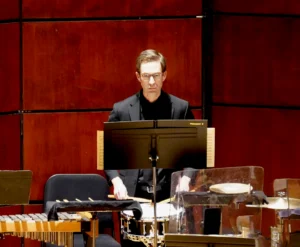
Mark’s Opening Remarks
Mark Libby:
Thank you. I have a lot of great questions ready, and I’d love to open things up for conversation. But what I thought I’d do tonight is start by sharing a little about my background — how I got started in music, what my path looked like, and what it’s like to work with the symphony. What we do is pretty different from what most people imagine, so I thought it would be interesting to share some of that.
I’ll say a few words about my work with the orchestra, but first I’d like to play a short snare drum piece — just to make things a little more interesting.
Early Influence of Buster Bailey
This is a very short snare drum piece written by a very famous percussionist — famous in the percussion world, at least. His name was Buster Bailey. He was with the New York Philharmonic from 1949 to 1991. If you ever watched orchestral performances on television in the ’50s and ’60s, Buster was one of the guys in the back playing drums.
One reason I mention him is that he wrote this piece for a television program. I’m hoping you’re my perfect audience for this — do any of you remember Omnibus? Yes! Some of you do — you’re not faking it. When I mention it to people my age, they have no idea what I’m talking about. But it ran for about eight seasons on Sunday afternoons in the ’50s. It featured programs on science, the arts, and the humanities — you can find some of them on YouTube. Buster wrote this piece for the show, apparently as an introduction to a segment. My teacher in Cleveland had a copy of a copy of a VHS. I’ve seen it — though it may be the one thing in the world that’s not on YouTube.
Anyway, this is a short snare drum piece by Buster Bailey. Fair warning — it’s quite loud.
[Mark performs a snare drum piece.]
Buster Bailey Stories
Thank you. Buster was a tremendous musician. He taught at Juilliard for many years and influenced generations of percussionists. My Buster Bailey story: I met him once. I didn’t study with him directly, but many of the people I studied with did. That’s one of the interesting things about music — there’s a lineage. My teacher studied with Buster, so even though I never met him directly, I feel like I absorbed his ideas about music and playing secondhand through his students.
When I was in high school, I went to the Aspen Music Festival in Colorado. Many of the faculty there were from New York, so I heard plenty of Buster stories. I graduated from high school in 1992, right around the time Buster retired. I auditioned at Juilliard that year — and there he was at the table. The principal percussionist of the New York Philharmonic, sitting right there. I was setting up my drum when he asked, “Where are you from?” I said Wisconsin. He said, “I’m from Wisconsin, too — have you ever been to Baraboo?”
I knew Buster loved circus music. He had a real joy for life — that’s why I brought the picture. Whenever people talk about Buster, they mention his infectious enthusiasm. He loved circus music so much that he’d go play with circus bands in the summers. And in Baraboo, Wisconsin, there’s the Circus World Museum. So when Buster asked if I’d been there, I said, “I don’t know much, but I have been to the Circus World in Baraboo.” Buster lit up. He was thrilled — like it was the most exciting thing. That was my Buster Bailey moment. Unfortunately, it was all downhill from there.
Background in Music
Mark Libby:
I’m from Wisconsin. I didn’t grow up in a particularly musical family — my dad was musical, and his mother was a vocalist — but I wouldn’t call us especially musical overall. I was fortunate to be part of a strong public school music program, and I had a wonderful private teacher. So it was a really good environment to grow up in.
I went to the Aspen Music Festival in high school, encouraged by my teacher there. It was eye-opening — being around older students, including college- and conservatory-level players. Being one of the youngest, I barely knew what college-level playing looked like, but being around those students opened my eyes. I auditioned for music conservatories after high school and ended up at the Cleveland Institute of Music, and loved it. I lived in Cleveland for eight years. Just really tremendous years of my life.
As mentioned, I played part-time with the Dayton Philharmonic for three seasons and was fortunate to secure a position here. That audition was around 2000, and I’ve been here ever since. I’ve really enjoyed being part of the Birmingham and Alabama community. I love bringing my colleagues and the great music we perform to our audiences.
Q&A — Instruments and Practice
Audience Member:
How many different instruments do you play? Do you play them all equally well, or do you favor some over others?
Mark Libby:
That’s one of the things I really enjoy about being a percussionist — we play a wide range of instruments. Most of us start on the snare drum. I grew up in Wisconsin, and my next-door neighbor had a drum set, which became my entry point. I played in marching band and jazz ensemble, all of it as a kid.
Then you branch out. You learn the keyboard percussion instruments — marimba, xylophone, vibraphone. I had to learn to read pitched music, and I was terrible at it at first. Snare drum music is all on one line. Then suddenly I had to read a full staff on the marimba — it was awful. It took me forever, but I stuck with it, and now I play all the keyboard instruments. Triangle, cymbals — we can talk about those in a bit.
It’s one of my favorite things about being a percussionist — the variety. It’s not easy. A piano player might practice six hours on one instrument. I might spend four hours on a single marimba piece, then four hours on a snare piece. But it’s its own kind of fun.
Practice Time
Audience Member:
How do you practice at home? Do you have all of that at home?
Mark Libby:
I’m in the basement. [laughter] I have a little studio down there. I have a marimba at home, a xylophone, a wood block, steel instruments, and drum gear. Most of us have what we need at home. It’s not a small investment — I told my daughter, when she started violin, that we’d start with a starter instrument and see how it goes.
Timpani
Audience Member:
We saw you playing timpani at a concert a while back. Do you enjoy it? Does it feel very different from other percussion?
Mark Libby:
I really do love playing timpani. When I was in college, I thought maybe that’s the direction I’d go. In a professional orchestra, it’s typically split — you’re either a timpanist or a percussionist. Jay Burnham is our timpanist, and he’s fantastic. He plays all the timpani. Lucas Vogelman and I play in the percussion section. By necessity, most people focus on one or the other because preparing for auditions for both is extremely demanding.
But I love playing timpani whenever I get the chance. The big difference is intonation. As a percussionist, you generally don’t worry about intonation — it’s set. With timpani, you have to tune the drums, and the pitch can drift during a concert as the heads respond to changes in temperature and humidity. You need a great ear. It’s very demanding that way, but also really rewarding — you feel even more connected to the orchestral sound because your pitch blends with everyone else’s.
Historically, timpani heads were made from calfskin. They sounded beautiful but were incredibly susceptible to weather changes — real humidity nightmares. Now they’re plastic, which is much more stable. But people still use natural heads, especially in period instrument ensembles. They sound fabulous. You just have to take very good care of them.
Tuning
Audience Member:
Is there a tuning gauge that helps?
Mark Libby:
Yes — there’s a gauge on the drum that gives you a reference point. It helps a lot. You can tune the drum, note where the gauge reads, and then check it during the concert. But you still have to use your ear as the final judge. The gauge tells you where you were, not necessarily where you need to be right now.
Counting Rests — The Percussionist’s Challenge
Audience Member:
How do you know when to come in? What does your music sheet look like?
Mark Libby:
A lot of the time, we’re not playing — we’re sitting and counting. We might sit for a very long time, then stand up and play a few notes, then sit back down. The part can show something like “tacet,” which means don’t play until further notice — for a long stretch. And then it’s like, wait, how long was that? [laughter]
It is genuinely difficult. We have to know the piece and the score well enough to track where we are. I always tease string players — and my wife plays violin, so I can say this — because they can’t count rests. If they have a long rest, they’re lost, because they’re used to always playing. We might have concerts where I play 30 notes total. Those guys play 30 notes in the first two minutes. So, to be fair, they face a different kind of challenge. But counting long rests is a real skill in our world.
Unusual Instruments
Audience Member:
What’s the most unusual instrument you’ve ever had to play?
Mark Libby:
Great question. In the percussion section, we get to play some unusual things — especially in contemporary music. Bottles, trash cans, big metal plates. I’ll tell one story.
There’s an instrument called a lion’s roar — it’s a friction drum. It has a head like a regular drum, but with a rope or thin rod attached to the center of the head. You pull on it, and the friction vibrates the head, producing a sound like… well, a lion’s roar. [demonstrates sound] Composers like Varèse used it often.
I played it once with the Cleveland Orchestra when I was a student on tour, and we were heading to Carnegie Hall. I was playing the lion’s roar in a Varèse piece. We had 13 people on stage, which probably explains how I got pulled in. We played through it, and Christoph von Dohnányi — the conductor — stopped and said, “Let me hear the lion’s roar.” I froze. I was 22, a senior in college. My teacher, Richard Weiner, the principal percussionist, was on the other side of the stage. I looked over at him, and he just looked away. [laughter]
I played it again. It turned out the issue was the drum itself — they had a new drum on tour, and Dohnányi remembered the old one. The old drum was white; this one was blue. He noticed it was a different drum. So no matter how I played, he was not happy. It was humiliating in the best possible way — you’re trying to make this intentionally strange sound in front of everyone. But I survived.
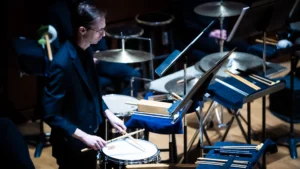
Snare Drum vs. Keyboard Instruments
Audience Member:
Do you find it difficult to switch between unpitched instruments, such as the snare drum, and melodic instruments, such as the marimba? They seem so different musically.
Mark Libby:
That’s a great question, and you’re right — they are different. But hopefully not as different as you might think. One of the things we’re taught, going back to Buster Bailey’s approach, is to play musically even on the snare drum — to maintain a musical line, phrasing, and shape, just like a horn player or a pianist. So the goal is to bring that same musicality to everything, even instruments that don’t have pitch.
We’re also taught to develop a technique that’s loose and relaxed enough to transfer across instruments — not a completely different technique for each one. You don’t want tension; you don’t want to choke the stick or the sound. The goal is for what you’re doing on the marimba to feel fundamentally similar to what you’re doing on the snare drum, even though the musical content differs.
The field has changed a lot. It used to be that players specialized — you were a drummer or a keyboard player. That’s not really the case anymore. Players like Lucas, our newly hired percussionist, are fantastic keyboard players and equally strong on all the drum instruments. The expectation now is that you do it all, so we’re all adapting and growing.
Practice Alongside the Orchestra
Audience Member:
Since so much of what you play is in context with the rest of the orchestra, do you practice your part alongside the other players’ parts?
Mark Libby:
Yes — great question. Most of my personal practice, especially for technically demanding work, focuses on working through the technical challenges at home first. When we get together in rehearsal, time is limited, and we’re focused on the musical ensemble work — fitting our parts together and responding to each other. So I do both. The technical groundwork happens at home, and a big part of that is score study — really learning how my part fits into everything else, so when I get to rehearsal I’m not just reading my notes in isolation.
Favorite Works
Audience Member:
Do you have a favorite piece or two that you especially enjoy playing?
Mark Libby:
I get that question a lot, and my honest answer is that I don’t have a single favorite. What I love is playing any work where the percussion writing fits beautifully and serves the music. Not all scores use percussion well — it’s not a given.
But a direct answer: one of my absolute favorites is a piece we performed at the Carver Theater on April 23, 2026. It’s by the French composer Darius Milhaud, who traveled extensively — including to Brazil, which influenced some of his work. Milhaud came to New York in 1922, went up to Harlem, and heard jazz and dance bands at the very beginning of the jazz era, and he was captivated. He wrote this chamber piece for about 17 instruments, very jazz-influenced, and the drum set part he wrote is remarkable, because at that point, the drum set as we know it barely existed. Players in New Orleans were still figuring it out: a bass drum on the floor with a pedal, cymbals lowered on a stand so one person could play everything.
Milhaud saw that happening in Harlem and went back and wrote this part. It’s not a modern drum set — it’s a bass drum with a pedal, a small cymbal attached, and some woodblocks. Very 1920s. But the writing is just terrific. I love jazz; I love the chamber-music aspect of the piece, and it’s beautifully written for the instruments. I’m really looking forward to it.</p>
Teaching
Audience Member:
Do orchestra members typically teach on the side?
Mark Libby:
A lot of us do, yes. I don’t teach very much myself. And I’ll be honest — I think there’s a common misconception that being a good performer makes you a good teacher. That’s not necessarily true. Teaching is its own skill. It’s hard for me to turn off the critical, analytical part of my brain that got me to this level and just be encouraging and patient — not make a kid hate music. [laughter]
I will say, though, that having my daughter play the violin now has been a completely different and wonderful musical experience for me. Not as a professional evaluating every note, but just as a parent enjoying her joy in it. That’s been really special.
There are many excellent teachers in Birmingham, and I have tremendous respect for them. It’s a genuine skill, and I refer students to those teachers all the time.
Audience Member:
When do you practice, given your family life?
Mark Libby:
In the basement. [laughter] Definitely in the basement. Usually in the mornings and afternoons. When kids are in school, from around 8 to 2:30, that’s your window.
Cleveland Institute of Music — Anecdotes
Audience Member:
Do you have any favorite memories or stories from your time at the Cleveland Institute?
Mark Libby:
I was so fortunate there — I didn’t fully realize it at the time. The Cleveland Institute of Music is a very small conservatory, and the Cleveland Orchestra is right there. We’d go to concerts on Saturday night, and those were our teachers at the Tuesday morning lesson. Walking down the hall, you’d see John Mack — the principal oboe — just right there. That was the environment.
One story: we had a guest artist come in for a masterclass — Bob van Sice, a fantastic marimba player who had studied at CIM with Cloyd Duff, the legendary timpanist with the Cleveland Orchestra. He’d become well known for his marimba playing. He had a reputation for being intense in masterclasses — if you weren’t prepared, he let you know. So when he came, my teacher Richard Weiner made it very clear: be ready.
Richard and the other faculty were there for the first hour or so. Everything went smoothly. The moment they left, the atmosphere changed. For anyone who maybe hadn’t quite prepared as much as they should have — well, Bob was not shy about pointing it out. It was a great lesson in showing up prepared. I learned a lot.
Another memory: I was in the basement one day practicing timpani when some of the brass players were having a sectional upstairs. They needed timpani for the Beethoven Third Symphony, so they grabbed me — come up, come do this. And there I was, playing with the principal trumpet of the Cleveland Orchestra in a student sectional. How lucky is that? You just can’t replicate that kind of environment. Seeing that level of musicianship up close every day — it’s so fortunate.
Brake Drums and Unusual Sound Sources
Audience Member:
We were at a concert and noticed someone in the percussion section playing what looked like a real car brake drum. Is that right? What kind of sound does it produce?
Mark Libby:
Yes, absolutely! We use brake drums all the time. They’re literally automotive brake drums — I went to a junkyard off I-65 and picked out a bunch of them. [laughter] I put them in the trunk and drove back. They produce a great metallic sound, kind of like an anvil — in fact, in some pieces the part is actually marked “anvil,” and we use a brake drum to simulate that sound.
Contemporary music calls for a wide range of creative sound sources. Oxygen tanks are another example — different sizes produce very resonant, almost-pitched sounds. It’s exciting, actually. Sometimes a score is very specific: “I want a wood block exactly three inches long, struck with this type of mallet.” That’s thrilling because you get to explore and find exactly the right sound. We always try to honor those specifications while trusting our own ears.
Favorite Concerts
Audience Member:
Are there any concerts you’re particularly excited about?
Mark Libby:
Definitely the April program at the Carver Theater — I already mentioned that piece, and I’m really looking forward to it. Also, we’re performing Carmina Burana in the first week of May with the Alabama Ballet. I always enjoy playing it — it has a lot of great percussion writing. It gets a bit of a reputation for being overplayed, but it’s genuinely fun to perform.
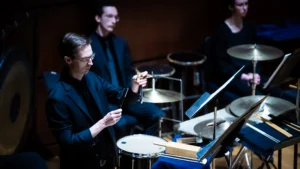
The Triangle
Mark Libby:
I brought a triangle tonight and want to pass it around — because it’s the instrument people always ask about, usually with a smile, as if it must be the easy one. But it’s actually quite difficult.
One of my favorite triangle stories involves a television program — there’s a clip on YouTube of journalist George Plimpton, known for participatory journalism. He embedded himself in different worlds to write about them — he played football with the Detroit Lions, that kind of thing. He also played the triangle in a rehearsal with the New York Philharmonic under Leonard Bernstein.
Bernstein stops the orchestra, looks at Plimpton, and says he wants to hear the triangle. Plimpton is absolutely terrified — as he should be. He’s alone on a single note in front of a full orchestra, with Bernstein staring at him. Plimpton said afterward that he’d never been more frightened. That’s the reality of the triangle — when you play it, everyone can hear you, and you usually have to play very softly. One person, one note, total exposure.
So, let’s pass it around — give it a try.
[Triangle passed around the audience. Laughter and audience participation.]
The piece I’m referencing is Liszt’s First Piano Concerto, which is famous in the classical world for its triangle part. There’s a prominent solo that has been the subject of many jokes — and much terror — over the years. But it’s a gorgeous piece, and that triangle note matters. Thank you all — you did great.
Experience It for Yourself
Insider Evenings happen twice a year, offering donors an up-close look at the orchestral world — from the musicians who bring it to life to the production team that makes it all happen.
You can be part of it with a yearly commitment of just $100, which works out to a little over $8 a month on a recurring plan. View our full donor benefits here.
And if you step up to $250 or more annually, you’ll also gain access to Conductor’s Corner — an exclusive conversation with our conductor about their artistic process and what goes into preparing each concert program.
These are the moments that turn audience members into true insiders.