
.. time In a previous blog post, writer Nicky Swett heard from ASO string players about their experiences searching for instruments. In this article, he speaks with Alabama Symphony Orchestra musicians about how they came to their wind and brass instruments.
The contrast between searching for brass instruments and string instruments
I began by asking Alabama Symphony Orchestra musician Masa Ohtake about how he found the trombone he plays on. He immediately formed a contrast between searching for a brass instrument and looking for string instruments. “I’ve had string playing friends go through finding a bow and how heartbreaking and excruciating and difficult and possibly financially destructive that process can be. The most expensive orchestral-style trombone you can buy is probably a type of German horn, which costs 10-15 thousand dollars.” Professional-grade string instruments, on the other hand, start in that range and can go up to hundreds of thousands, or even millions. “That’s a very different category of stress,” Masa exclaimed, though he acknowledged that the purchase of any high-level orchestral instrument is a substantial investment.
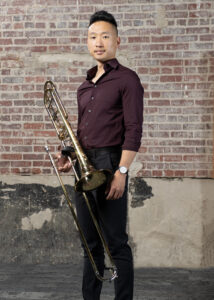
Brass instruments and some woodwind instruments are quite customizable. “This is just my opinion, but metal has less personality than other materials that are used in instrument making. The difference changing from metal to metal is not the same as from wood to wood,” Masa told me. Parts can be swapped for one another and adjusted with relative ease. This means that for wind and brass players, the search process often involves assembling a new instrument rather than finding one that is already out in the world, ready to go.
The search for the right instrument is still involved and demanding
That certainly doesn’t mean it’s necessarily a less involved and demanding process. “I tried more flutes than I could count,” flutist Tessa Vermeulen told me. “My time was spent trialling many different makers, emailing them, and asking if they could send me a couple with various specifications. I didn’t really feel a serious click with any of them until I tried Kanichi Nagahara flutes. My search immediately narrowed when I tried these. They have this vibrancy and immediacy of response that was really attractive. Nagahara flutes have the capacity for a lot of power. I don’t want to feel like the flute can’t quite take this amount of air, or it can’t do this extreme of a dynamic.”
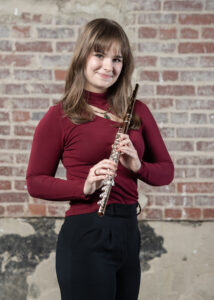
Because Tessa was planning to commission a newly-built flute, rather than buy a pre-made one, she had the chance to get things just right. “He made one body to my specifications, but I was debating between two head joints—the same material, but a very slightly different cut. He made two of them and he sent them both to me. It was very subtle, both of them were great, but I ended up picking one.”
I asked Tessa about what helped her to make that decision. “Head joints are the main element of the flute that determines the sound,” she explained. “It was about which specific cut was going to alter the direction of the air ever so slightly in a way that was going to feel more like my voice. The cut that would make me feel physically empowered to do whatever it is I want to do. One of them felt a little bit more direct in terms of where the air was hitting. Another was slightly more diffused. I ended up picking the one that was more direct, because it felt like throughout the various registers, and with different articulations and dynamics, I had the most control.”
The reality of the complexities of an instrument’s limits
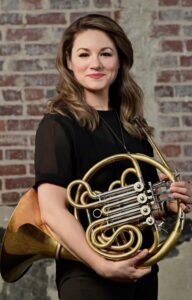
Principal Horn Valerie Sly wound up with her french horn after a long and sometimes frustrating string of these kinds of back-and-forth modifications on another horn. “I had been sending the horn that I had been playing on to this horn maker named Jacob Medlin. We had been trying to fix a couple little things in the instrument that weren’t working very well. At a certain point, he was like ‘I don’t think we’re going to be able to get some of these problems worked out the way that you want. We’ve kind of hit the upper ceiling of what this instrument can be.’”
She explained that horns are extremely sensitive instruments and that even great makers sometimes can’t fully explain why certain notes work well and others don’t. “The way that I would describe what it feels like to find notes on the horn is a little bit like throwing darts. The wiggle room that you have on each note is different.
“When you’re in the low register, you’re trying to throw a dart at the bullseye, but the bullseye is big and you’re like five feet away from it. It’s not that bad. As you get up into the higher register, you’re taking steps backward, and your margin for error becomes much smaller. But there can be certain notes where, for whatever reason, the way the instrument is vibrating, it feels like the bullseye is non-existent! There’s no stability to the note. You’re trying to balance a pencil by the eraser or the point.
Even the best horn builders in the world don’t totally know everything
“Even the best horn builders in the world don’t totally know how this works from a physics standpoint, because the way that the sound waves move through brass instruments is so complicated. On my old instrument, a couple of notes in the high register were what I would refer to as very squirrely! The horn just like didn’t want to snap into place on them – it felt like the slot was non-existent.”
Jacob, the horn maker she was working with, suggested that he could get further with a different instrument. “He suggested that it would actually be better to take a Yamaha, which are horns that horn makers love to work on because they’re very consistent, and do a bunch of tweaks to it. He knew what the outcome would be.” Fortuitously, Valerie’s backup instrument happened to be the exact Yamaha model he suggested, and so she quickly shipped it his way. “It has a whole new bell that’s his, a whole new lead pipe that’s his. There’s a ton of work to the body of the horn. It’s sort of half Yamaha and half his. He sent it back to me and I really did not know what to expect. I played on it and it was amazing. I never went back to my other horn!”
The timing of “The Search” is unpredictable
The musicians I spoke with all initiated instrument searches at different stages in their careers. Masa, for his part, was adamant that it is important not to look for an upgrade too early on. “I think it’s generally good practice when you’re young and developing not to look outwards for solutions but to look inwards. Become a better producer of sound before we start to think, ‘if I change this about the instrument, it’ll make me better.’
“I see a lot of students spend a lot of money changing stuff out every semester. If you have the resources, great. But if you don’t, really make sure that you have all the fundamentals in place. Get to the point where you know the way that you want to present your sound, what you need from a trombone in an orchestra job, and what you need to fit in the section. That kind of clear picture is what navigated me toward my instrument. It’s like buying clothes. You don’t want to buy the nicest designer things if you know you’re going to grow 6 inches in the next year!”
Know the goal and have a target in mind before starting the process
Masa decided to get a new instrument shortly after he won his job in the ASO, and once he started the process, he really enjoyed working with a trombone maker in Boston. “They do fittings for you, these instrument makers. They have hundreds of different trombone slides! For different components, you can get rose brass, yellow brass, gold brass, nickel, sterling, and silver. It’s interesting. I’m glad I went through it. I know a little bit more now, I feel better equipped to talk about it, but I felt very lucky to know what I was going for and have a target in mind before I started the process.”
Tessa also noted the importance of really knowing her own sound. She brought that knowledge to the decision-making process for possible flute configurations. “The more diffuse head joint had some specific [tonal] colors that I liked. One or two colors were slightly more difficult to achieve on the one I ended up choosing. But I decided I wanted something that would give me a super-solid base. I can now make my own colors on top of it. As soon as an instrument is imposing some sort of color or condition on your playing across the board, it’s taking your options down a notch.”
I was struck by the difference between this mentality and that of string players I have spoken with about their instrument searches. They expected that the violin or cello they chose would have its own inherent sound that would force them to adjust their playing style in various ways. Perhaps the potential for customization in wind and brass instruments also creates a different set of expectations. All scenarios create a unique relationship between the player and the instrument. “I believe the best instrument is a blank slate,” Tessa proposed. “That’s how you know that you found the right instrument for you: if it’s physically comfortable and if it feels like a blank canvas.”