
.
Cellist, writer, and musicologist Nicky Swett speaks with Alabama Symphony Orchestra musicians Lauren Peacock and Boyu Li about how they came to the string instruments they play on.
The transition from early beginnings to “The Search”
Many string players have little memory of the very first instruments they used. “I started on violin when I was three. I think I had one of those cardboard violins,” Lauren Peacock, Assistant Principal Cellist of the Alabama Symphony, told me. “When I was five, I asked to switch to cello. I don’t think I had a cardboard cello, but I had one of those little baby wooden ones that probably didn’t sound too good.” As kids get older, they often go from instrument to instrument without having much input about what they are playing on. “When you’re really young or in high school, you don’t know exactly what to look for. Your teacher often helps you find the instrument,” Lauren explained.

At a certain point, performers who have decided to play professionally begin thinking more actively about the tool they bring on stage every day, and they look for something that can take their playing to a different level. This can happen at various career stages. Lauren began seeking a cello after she had completed her master’s degree, while she was playing in The Orchestra Now, a training orchestra in upstate New York. “It was the first time I searched for a cello after developing my ear in college. When you look for an instrument at that stage, you have wants of your own: your sound, the colors that you are going for, a sense of what feels right to you. Looking for an instrument is a scary, long, but special process to go through.”
“The Search” is a long, challenging process
At times, the search can be daunting. “There are so many options out there, it can be overwhelming. Your ears get tired after a while!” Lauren admitted. “You have to take a break. Kind of like if you smell too many fragrances, it just gets confusing.” She mentioned that it was helpful to have friends who were looking at the same time. “One friend and I went to Boston together, and we would play for each other, which was really helpful. The shop that I got my instrument from, Carriage House, has a little recital hall. They would bring 10 or so cellos in, and my friend and I would play them for each other and get instant feedback from each other.”
Professional-grade string instruments range in price from $10,000 to millions of dollars. While the people running shops are often very generous and helpful, there are high stakes around every purchase. “They’re trying to sell you something—that’s their job,” Lauren acknowledged. The key is to demonstrate the instrument in different contexts for as many colleagues and mentors as you can before committing.
“The instrument often sounds very different under your ear than it does far away. Is the instrument bright or dark? Is it loud or soft? Does it have a lot of core to the sound? You have to play for people in a big hall to know that what you’re hearing is getting translated out into the audience.” After a search of about six months, she settled on a modern instrument by a New Haven-based maker named Lawrence Wilke. “There were a lot of colors and sounds that I hadn’t been able to access on my previous instrument, and that really drew me to it.”
Each musician has their own journey in “The Search”
Boyu Li, Associate Concertmaster of the Alabama Symphony Orchestra musicians, had quite a different experience coming to his current instrument. He first recognized that he needed to use a new violin back before he applied for graduate school. “One time, I borrowed a violin during my auditions for Master’s. I went to the Fine Arts Building in Chicago to a shop with very nice violins. I just talked to someone and said ‘I’m auditioning for a good school and I really want to get in.’” They gave him a good instrument for a month, but he had to return it when he finished his auditions.
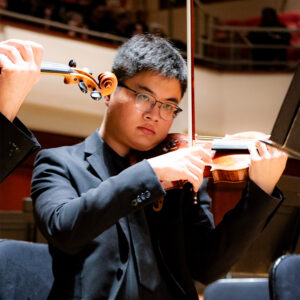
He began looking for a violin to use long-term more recently, while he was studying for his Doctor of Musical Arts degree at Boston University. “I started taking orchestra auditions, and the instrument I had was really bad. I don’t think that instrument was going to help me to win a job.” He started his process by looking for a sponsor who would either lend him an instrument or help him to pay for one. “There are a lot of foundations out there if you don’t have a personal connection. You can send your resume and recordings. If you can win a competition, that’s even better,” he explained.
Sometimes the journey of “The Search” provides great insight
Boyu was fortunate enough to connect with Mr. Zhou, a private sponsor based in Boston, who offered him a loan of an 1808 violin by Nicolas Lupot, an esteemed French luthier (the official term for a string instrument maker). “When I met Mr. Zhou, he actually had two violins available,” he told me. “The Lupot, which is quite valuable, and then also a violin by Giuseppe ‘del Gesù’ Guarneri, which is worth like $1,000,000! I tried the Guarneri first. But when I tried to play it, and I know it wasn’t my fault—it didn’t sound as good.
“From that point on, I knew that the price tag didn’t always track with what musicians want. It means a lot to the dealer or at the auction. But for the musicians, you can find the personality of the instrument right away and know if it’s the sound that are looking for. The Lupot had a lot of warmth. A lot of essence in the sound. I knew it was a great violin. Still, it wasn’t a very easy violin to play at first because the bridge was high, which meant the distance between the string and the fingerboard was large and it’s more work to put your finger down.”
The result of “The Search” might be a surprise
Boyu discussed the palpable effects this instrument has had on his approach to playing. “Having an old violin is a learning process. I used to play in a way that was pretty tight and not comfortable. These old instruments can teach you a lot of things because there are only one or two ways that you can make the instrument sound really good. I learned a lot about how I’m playing, and I started trying to be more relaxed to bring out the instrument’s natural sound rather than the sound I want to put on it. You have to adapt to the instrument. It has its own voice.”
Lauren had a similar experience, subtly shifting her playing in response to the instrument she chose. The shape of her cello is modelled on instruments by Matteo Goffriller, a 17th – and 18th-century Venetian luthier. Gofriller-style cellos have relatively large bodies, which can take some adjusting when you start playing them. “I had to learn to relax a lot more,” she explained. “I couldn’t muscle the sound out! You’ve got to let your gravity—your natural arm weight—get the most beautiful tone from the instrument.”
Though the search process can be intense and stressful at times, the instruments themselves can take some getting used to. The reward is often a lifelong musical companion. For Boyu, there was a close connection straight away: “I knew immediately when I started playing the Lupot, from the first note, that it was the right one.” As Lauren said of her cello with a smile and a laugh, “It’s a big, big friend.”
–Nicky Swett, cellist, writer, and musicologist, 2025