
By Emma Kosht, Alabama Symphony Orchestra Librarian
The first piece of tonight’s program has just concluded, and Maestro has exited the stage. Without much ado, a person carrying a score (a book of music from which the conductor conducts) walks out onto the stage and steps onto the podium. You may be wondering who that person is and what they plan to do up there. Are they going to conduct the rest of the performance? Are they a lost musician? No, that would be the orchestra’s librarian; a role that is mostly unknown, but crucial to the orchestra’s performance. She places the score on Maestro’s stand and quickly walks off, allowing the performance to continue.

My name is Emma Kosht; I am the head librarian of the Alabama Symphony. Orchestra librarians are trained as classical musicians and apply those skills in their daily work as librarians. I attended the Cleveland Institute of Music, where I studied trumpet performance and began my studies in the Cleveland Orchestra’s library. One of the leading and crucial roles of the orchestra librarian is being able to put myself in the musicians’ shoes and decide what would work best from their perspective. You will not typically see orchestra librarians with degrees in library science; for this reason, we mainly function as musicians within the orchestra.
So, what does an orchestra librarian do? In short, we oversee all the music on the stage and in the orchestra’s collection. I oversee procuring, licensing, and cataloging all the orchestra’s sheet music, which is an enormous task for such a large ensemble. With our typical season featuring over 40 different programs, we prepare several thousand parts. In addition to this, I work on correcting parts, repairing damaged materials, addressing issues that may arise during rehearsals, and liaising with other staff members on hiring needs, as well as copyright issues related to the music itself and its performance. Aside from the music preparation part of my job, I also rent or purchase any music needed for a program from various publishers, conducting extensive research on specific editions and versions to ensure I acquire the best option for our orchestra. Orchestra librarians must also maintain a close relationship with the conductor of any given program to discuss any necessary changes or musical questions, as well as the actual music being used.
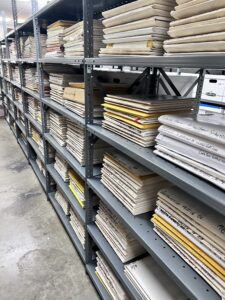
When the repertoire for a program is finalized, several steps in my preparation process begin months before the program is performed on stage. Firstly, I assess the pieces in the program and determine which ones we already have in our library. If there are any pieces that we do not own, I will either purchase them (if they are in the public domain) or rent them (if they are not in the public domain) from their respective publisher/music dealer. If we have some or all the pieces in our library, I will make a trip to our offsite library, which also functions as our music storage room, in the basement of the BJCC Concert Hall. Once all the pieces, whether new or already owned, are in my main library at the Alys Stephens Center, I will begin assessing what needs to be done to make this program performance-ready.
Firstly, I will provide the instrumentation needs for this program to the ASO’s Personnel Manager so that he can begin hiring any necessary musicians, and to our Stage Manager so that she can start planning the stage setup and how everything will fit. Depending on the amount of time before the music must be ready, I may thoroughly proof the parts (what the musicians play from) against the score (what the conductor conducts from), or may correct the music from an already compiled list of errors in the given work from my colleagues in other orchestras. To “proof” the parts means to check their correctness against a master copy (in this case, the score), just like an editor would edit a new edition of a book. This process is very rewarding once complete but can be an extremely lengthy and challenging task.
Following this, the “bowing” process begins. When you are watching the orchestra, you may notice how the string players’ bows all move in the same direction. The way the orchestra chooses to bow a passage is not by chance or luck; this is a carefully thought-out system that our principal string players decide. First, the music is given to the concertmaster, who writes all their desired “bowings” into the part using various symbols. Following the concertmaster, the music is then given to the principal 2nd violin, principal viola, and principal cello. All of them receive their respective parts, along with a copy of the 1st violin’s music. Once their bowings are complete, the last phase begins, with the music going to our principal bass, who receives their music along with a copy of the principal cello’s music. After the five musicians decide the bowings, the library transfers all those bowings into the respective section parts, and scans everything so that the section players may practice using those bowings prior to the first rehearsal. Next time you see the string’s bows moving in unison think of this process that occurs to make that moment happen.
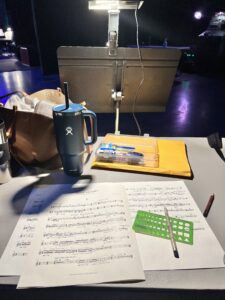
Aside from the parts being bowed, the next phase of preparation is inputting any needed cuts, inserts, edits or notes from the conductor into the parts, as well as fixing any parts that have rips or tears, any notes that are hard to read or any other fixes. We must also ensure that the musicians have enough time to turn the page, which may require some creative editing or Tetris-style thinking. These tasks do not always happen; sometimes we play a piece just as it is, and all the music is perfect, but this can also be a long process, depending on the work being performed. When we perform with the Alabama Ballet or the Birmingham Opera, we occasionally need to make numerous edits to accommodate the dancers’ or singers’ specific needs. When we performed Giselle with the Alabama Ballet in the Spring of 2024, each part required over 70 cuts to be made so that the music fit the choreography.
We must also confirm that the musicians’ parts all use the same rehearsal system as the conductor’s score. Rehearsal systems are markings that musicians and conductors use during rehearsal to confirm they are starting from the same place or discussing the exact moment in the music. If they are different or missing, it can be detrimental to the rehearsal, as a significant amount of time will be spent trying to figure out where they are in the music. Imagine trying to get to the same page as someone in a book, without any marked page numbers – that is what a rehearsal is like with no (or different) marking systems. Finally, the music is placed into the folders for the musicians to pick up for practice, becoming available at least two weeks before the first rehearsal.
Of all my functions, the most important is making the musicians’ and the conductor’s jobs as easy as possible. I want them to be able to focus on making music in rehearsal and concerts, not having to fuss with the paper in front of them. This is especially important for a professional ensemble like the Alabama Symphony, as we typically rehearse a piece only once or twice before a concert. With this rehearsal schedule, there is no time for misprints or errors in the music. The goal of my work is to resolve all potential problems that may arise during a program well in advance of the first rehearsal.
As the conductor re-enters the stage and the orchestra begins once more, take a moment to think about all the work that goes into making each performance special for the audience, not only the hard work the musicians have put in, but all the behind-the-scenes work from every facet of our organization, and enjoy the concert!