
In a new series of Alabama Symphony blog posts, cellist, writer, and musicologist Nicky Swett interviews ASO musicians about their summer activities.

On May 25, 2025, the Alabama Symphony Orchestra rounded out the 2024-25 season with the rousing fanfare at the beloved annual free concert series “Symphony in the Summer” at Birmingham’s Railroad Park. The musicians don’t start rehearsals for the first concert of 2025-26 until the end of September. Four months might seem like a long pause, but musicians are never really off the clock. “It’s quite a long break,” assistant principal flutist Tessa Vermeulen said to me when we spoke earlier in the summer. “What always ends up happening to me is that I think I’m going to have all this free time, and then I fill it with a bunch of stuff and end up being really busy.”
She spent the first half of the break preparing for a solo recital in Chicago at the end of July, part of the Dame Myra Hess Memorial Concert Series. “They let me pick whatever program I wanted, 40 minutes of my favourite music,” she told me. It included pieces by Tchaikovsky, Samuel Barber, Robert Schumann, and also a sonata that she commissioned from a friend and colleague from Juilliard, Colby Kleven. She presented this last piece again in August at the conference of the National Flute Association in Atlanta—“The biggest gathering of flute nerds in the world” as she put it. “There are performances, panels, and master classes covering everything about playing and professional development. It’s a great chance to try instruments, because they’ll have a huge area where all the flute makers are represented. It’s also an opportunity to network with various flutists. At the end of the convention, they have a gala performance, where they bring in some of the most high-profile professionals from around the world to play with an orchestra.”
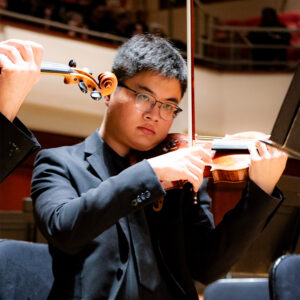
For Boyu Li, who joined the symphony as associate concertmaster in January, this was a relatively laid-back summer. “Usually, I have a lot of things to do in the summer—I go to festivals, or I head back to my home country.” He told me that since he was transitioning from a student visa to a work visa, he mostly used the time to study for upcoming exams at Boston University, where is finishing up a Doctor of Musical Arts degree, and to settle into life in Birmingham. “I’m trying to work on my driver’s license,” he explained. “I have lived in the States for 10 years and it never came to my mind that I would need to know how to drive! Now I need a car to go to work.”
I shared with Boyu that I had to take the road test three times before finally getting my license. “People always say it’s so easy to get a driver’s license here,” he commiserated, “but I failed the first time because of a very stupid mistake! The judge wanted me to show her the lights. She said to turn on the ‘emergency light.’ I was like, ‘What does that mean? Do you want the emergency brake or the hazard light?’ She didn’t really say yes or no, just kept saying ‘emergency light.’ It was off to a bad start, so even though we went through the rest of the test, I think that was the reason I didn’t pass. But it doesn’t matter! I will make another appointment to take the test again.

All the musicians I spoke with mentioned that they enjoyed having more practice time during the summer break. Trombonist Masa Ohtake described how “when you don’t have a whole lot of high stakes responsibilities with your playing—like next week I have to perform this symphony or that recital—you can isolate your weaknesses and spend time working through problems. I’ve been going back to basics and taking care of some loose ends in my playing that I have neglected the last three years or so.”
I asked Masa what specifically he was working on in his playing during this period. “Very nerdy, trombone things like control in a specific register of the horn,” he answered. “I am going back through some solo pieces that I haven’t played in a while. We’re not required to do much of that in the orchestra, but I want to make sure that I’m still pushing my technique outside of what’s required on a regular basis.” He also mentioned devoting time to repertoire on the coming season—Ludwig van Beethoven’s Ninth Symphony and Aaron Copland’s Third Symphony both have major brass parts that need woodshedding.
In addition to practicing and preparing, Masa spent the summer doing some festival teaching and house hunting. But he told me he was very excited to get back to concerts with the ASO and his main teaching job, even though the season can get very intense and busy. “I think it’s because in a sense I don’t find it to be work,” he said in a reflective tone. “I get to do this crazy thing. Playing in an orchestra full time and also teaching kids how to be musicians and human beings—it’s insane. It’s the best.”
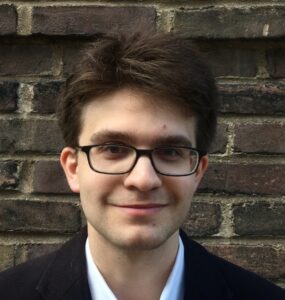 Nicky Swett holds a PhD from the University of Cambridge. He works as a program annotator and editorial contributor for concert presenters across the US and UK, including the Chamber Music Society of Lincoln Center, the New York Philharmonic, the BBC, and Wigmore Hall.
Read more articles by ASO and other contributors here.