
Mark Patrick’s Journey to Alabama Symphony Orchestra President
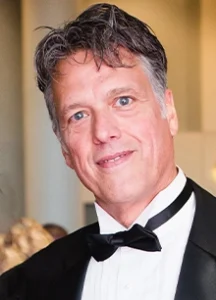 Mark Patrick has been the President of the Alabama Symphony Orchestra since 2019, but he’s been with the orchestra for nearly 25 years. His journey to the role of classical music steward has been somewhat unusual; it’s rare, in the orchestral world, to have a symphony chief who has come from a production background. But Mark’s long history with the organization has given him a love and appreciation for the ASO that he believes is unique, and even occupies a prime position in his living room—but more on that later. I sat down with Mark to talk about his years with the orchestra, his thoughts on classical music, and his deep appreciation for the city of Birmingham.
Early Years and Starting with the ASO
Mark was born in Nashville, but raised in Muscle Shoals, Alabama, an outpost of the Nashville recording scene and a hub for session musicians. One of those players was his step-father, who got Mark and his brother started playing guitar. He studied Civil Engineering at the University of Alabama, but could never quite shake the music bug, playing in bands on weekends, and eventually owning a record store in Tuscaloosa.
When he moved to Birmingham in 2000, he spent the first few years as a stay-at-home dad, but he couldn’t help but seek out the local music scene. Eventually, he started working with the ASO on the stage crew. “Some guys that worked on the Symphony crew had actually worked with a rock band I had been in years before,” he recalls. “They called me and asked if I wanted to come work as a crew guy.” Soon, he became the right-hand man to the production manager. After that person left, he stepped into the role, then rose to Director of Operations in 2006, and later General Manager. In 2019, after the departure of former Executive Director Cheryle Caplinger, Mark was asked to step into the role on an interim basis, which has since become a permanent appointment.
The Joy of Discovering New Music
Over the years, Mark has become an enthusiastic classical music fan, but he also feels that his more limited background with the genre has preserved some of its magic. For him, coming to classical music late has been a blessing, and even after being with the orchestra for so many years, he still revels in the pleasure of hearing a new piece for the first time.
“I can’t remember what piece it was, but I remember one of the first Masterworks concerts that I ever worked on the crew for. When the concert was over, I was just blown away. I thought, man, that’s an incredible piece!” Even now, he lights up at the memory. “I know that our musicians have been playing some of these pieces their entire lives, but this was the first time I’d ever heard it, and I was so amazed. I think that’s been the thing that’s made this such an enjoyable job, the fact that so much of it is new to me. We still play pieces every year that I’ve never heard of.”

Maybe that’s why, when I ask if he has a favorite composer, he, somewhat unusually, selects a living one. Obviously, he loves the old masters, he concedes, specifically citing Beethoven, but what he’s most excited about are the younger artists writing music now. He’s particularly enthusiastic about the music of Brian Nabors, the Birmingham native with whom the ASO has done several collaborations, including the major commission, Letters from Birmingham.
Being Part of a Changing City
That enthusiasm for watching progress unfold also spills over into his feelings about the city of Birmingham, itself, which he says has changed a lot since he first moved here in 2000.
“There’s just been so much progress,” he says. When he first started working in Birmingham’s venues, the downtown was pretty barren, he recalls, and the arts scene was just a shadow of what it had once been. The Lyric Theater, for example, had become a dumping ground of old props and equipment, and Mark remembers spending several weeks clearing it out. “The only place to eat [near there] was the Lyric Hot Dog Stand,” he says, so watching the recent investments in revitalizing downtown Birmingham has been very heartening. And the orchestra, he says, has a big role to play in the vitality and appeal of the city.
“Businesses that are looking for top-notch talent often are trying to attract people from out-of-state,” he notes, “and a lot of times they’re coming from areas that have a great arts scene, they have great restaurants. It’s a whole package. They want to come somewhere that has a great art museum, a great orchestra, a ballet, a zoo, botanical gardens. If Birmingham wants to be on the map with these other great metropolitan cities, we’ve got to have that.”
A World-Class Orchestra Close to Home
Mark believes that the ASO musicians more than meet the demand of a great orchestra. “We have a world-class group of musicians here in Birmingham, not flying in for a show and then taking off. They’re part of the community, they shop where you shop. Coming from the background of an amateur player, what continues to strike him most is the musicianship a professional orchestra brings. “I know how much you put into it,” he says. “If you just want to play with a little neighborhood garage band, it’s a lot of work. So I’m always really awed by the musicianship on stage. Whether it’s Masterworks, movies, or with the Indigo Girls, you guys can play anything”
In fact, watching people discover how good this orchestra is is one of the things he misses the most about being on the ground in production. When his job involved chauffeuring visiting soloists to and from the hall, he was often present for visitors’ first reactions to playing with the ASO. “I heard Yo-Yo Ma say, ‘Wow, I was not expecting that!” I think a lot of people come to Birmingham and kind of think this is going to be a small regional orchestra. And there’s nothing wrong with [those groups], but this group punches well above its weight, and I heard that so many times.”
Fond Memories from Years on the ASO Stage Crew
Mark looks back at his previous ASO posts fondly, and admits that being on the production side of things is where he has always felt most comfortable, a fact he guesses might stem from his engineering training. Those years also hold some of his favorite memories, and I’m treated to a story that he says is his wildest ASO memory.
In the days before settling at Railroad Park, the ASO used to close each season with shows at Caldwell Park and Fort McClellan. “After the show [at Caldwell], we would pack up the orchestra and go to Anniston, to Fort McClellan, and do a concert there on Saturday night. So, we would get loaded up at 3am or maybe 3:30, and early the next morning we would go to Anniston and do it all over again.” Fort McClellan is a massive old Army Base, and the portable orchestra shell would be set up outdoors. “It’s like a little city, and there was a giant quad that the stage would be set up in.” Today, the ASO crew constantly checks the weather during outdoor shows, but this was the early 2000s, before smartphones could give minute-by-minute updates.
“We had a grand piano on the stage, and all of a sudden, out of nowhere, a micro-burst thunderstorm hit. It happened so quickly that we couldn’t even clear the piano. The wind was blowing so hard that it blew music stands off of the stage. There was lightning, and we’re trying to take cover. The nearest buildings were pretty far away, so we were hunkered down on the stage.”
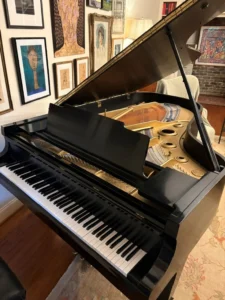 “Finally, it passed, and we were able to gather the equipment, and because there was a little gymnasium in one of the buildings, we were actually able to do the show.”
But then the crew faced the task of dismantling a sopping concert setup and loading it onto trucks that were quickly sinking into the mud. “I don’t know what time this was, but it was very late,” he remembers. “The only way we could get the piano off the stage was to take a giant rubber-wheeled forklift and inch it out to the road.”
Mark assumed that the piano was completely destroyed. “I said, I’m sure the thing’s ruined. It sat out in the thunderstorm. But [the piano tuner] called me back, and said, ‘man, this piano sounds great! I think it sounds better than it did.” The ASO tried to sell the piano, but with its soggy history, takers were hard to come by. “Finally, the price got so low that I just bought it, and it’s amazing!” That piano still sits in Mark’s living room, a little piece of insider ASO history.
ASO in the Community
In the end, Mark Patrick is a local musician at heart, and what’s most important to him about the ASO is what it offers the Alabama community. “I think one of the things that’s a huge void right now is music education in our schools.” Don’t get him wrong, he loves sports, but he believes that equal resources should be put into the arts. The ASO’s education programs currently reach 43,000 kids a year, and counting. “I really think that’s somewhere where we can make a difference,” he says. What the ASO also offers—and this is what lights him up more than anything—is a place for Alabama music lovers to gather and explore music that might be new to them. As he said before, there’s nothing more exciting than that.
But, funding an orchestra is no small feat. “It takes the same number of people to play a symphony as it did when it was written 300 years ago, and so it just gets more expensive every year to try to keep up. We’re fortunate that we’ve got people who realize how important it is.” He also notes that “there’s a reason why it’s called the Alabama Symphony Orchestra. It’s in order to serve the whole state. I would like for the state to realize what that means, the kind of asset that is, and invest in it. I think if that happens, there would be ways for us to get out and do more around the whole of Alabama.”
—Article by Valerie Sly, Principal Horn, Symphony Volunteer Council Chair, August 2026