
Thief, Poet, & Songs
Overture to La gazza ladra (1817)
Gioachino Rossini (1792-1868)
Runtime: Approx. 10 minutes
Like Shakespeare plays and Hollywood awards, opera was once strictly divided into distinct plot categories: opera buffa (comedies), opera seria (tragedies), and opera verismo (realism). And just as cinema today has grown more and more intent on defying categorization, opera composers also eventually pressed at the lines that separated their prescribed genres.
La gazza ladra (The Thieving Magpie) therefore falls into a category termed “opera semiseria,” equivalent to today’s “tragicomedy.” On one hand, the story is quite silly; Ninetta, a maid in a wealthy household, is wrongly accused of stealing a silver spoon. The real culprit is a magpie, a bird attracted to shiny objects.
On the other hand, the tale, which is based on the play La pie voleuse by Théodore Baudouin d’Aubigny and Louis-Charles Caigniez, highlights the hazards of existing on the lowest rung of the societal ladder. Ninetta quickly finds herself in real danger as she discovers that the draconian penalty for her supposed crime is death. To add insult to injury, the town’s mayor offers to help her out if only she’ll accept his advances. All this commentary on the nature of power is splashed across a backdrop of cartoonish antics and mistaken identity.
Though he composed 39 operas spanning all genres, Rossini is most known for his comedies today. It’s easy to see why; his readily identifiable style seems to perfectly encapsulate tomfoolery, a fact which is perhaps best demonstrated by the prodigious use of his music in Looney Tunes. However, while La gazza ladra certainly displays many of those elements, it does manage to take on a more serious tone.
The overture begins with opposing snare drum rolls that can be heard both as fanfare and as an ominous harbinger of execution. The stately opening gives way to bustling strings typical of Rossini’s more comedic stories, but it can never quite escape the snare drums, which underpin much of the piece. Birdlike solos in the flute and piccolo have an almost comic innocence, but ominous sonorities in the brass cloud the otherwise upbeat tone. For a story that mixes weighty themes into screwball comedy, the overture offers up a fitting encapsulation of what’s to come.
Piano Concerto No. 2 (1901)
Sergei Rachmaninoff (1873-1943)
Runtime: approx. 32 mins
Sergei Rachmaninoff was born in 1873 in Staraya Russa, Russia, and achieved fame in his lifetime primarily as a virtuoso pianist. Although he spent most of his career in Russia, he emigrated to the United States in 1917, where he found a much more receptive audience than he had often faced in Western Europe. Today, his music, particularly his piano concertos, has become a staple of the orchestral repertoire, with his works among the most frequently performed and beloved by audiences in the United States.
Prior to the composition of the Second Piano Concerto, Rachmaninoff had fallen into a major slump. His First Symphony had been roundly rejected, and he responded by drinking too much and composing too little. Eventually, in a bid for recovery, he began to undergo daily hypnotherapy. His doctor, Nikolai Dahl, reportedly employed the mantra “You will begin to write your concerto… You will work with great facility… The concerto will be of excellent quality…” to reignite his productivity. It appears to have worked—after several months of sessions, Rachmaninoff began to compose what has become one of the most famous piano concertos in the classical repertoire. Note to self: look into hypnotherapists in Birmingham.
Despite its legacy, the concerto was not altogether lauded upon its premiere. European critics found it to be shallow and overly simple. A 1927 Liverpool Post article deemed it a “somewhat catchpenny work,” with “plenty of rather cheap glitter.” But Russian pianist Nikolai Medtner heard something deeper, deeming the first movement’s sighing melody “one of the most strikingly Russian of themes… from the first bell stroke, you feel the figure of Russia rising up to her full height.”
It seems the unapologetically lush melodies and simplistic forms of Russian Romanticism did not resonate with European ears, and comparable criticisms also befell composers like Tchaikovsky, who similarly dared to infuse his music with that distinctly Russian sound. But if there’s anything I’ve learned from Taylor Swift, it’s that Americans love glitter! Jokes aside, Rachmaninoff, along with Tchaikovsky and a few others, did eventually find greater appreciation in the United States, and years later, melodies by both were turned into crooning ballads. It’s even been suggested that the second movement of this concerto served as the inspiration for the hit song “All By Myself.”
Saccharine as the piece may be, its languorous lines and pleasing flair scratch the kind of itch reached by rom-coms and action flicks. Every line finishes exactly as you hope it will, and it revels in its own beauty the way one lingers a little too long in the mirror after applying lipstick with a name like “Femme Fatale.” It’s a supremely satisfying listen that features a thrilling amount of pianistic flash and hummable tunes that—I warn you—will get stuck in your head.
Symphony No. 8 in G Major (1889)
Antonín Dvořák (1841-1904)
Run Time: Approx. 42 minutes
Here in the United States, Antonín Dvořák is most famous for journeying across the Atlantic to aid the burgeoning American orchestral world in developing a voice of its very own. This voyage resulted in his famous Ninth Symphony, From the New World, which the ASO performed just last season.
While the idea of soliciting a European composer to help construct American identity may raise a few eyebrows, Dvořák was selected for this unique task precisely because he had already done just that for his own homeland of Bohemia—now Czechia.
The practice of injecting non-Western sounds into classical music was not exactly new, but prior to the 19th century, snippets of so-called exoticism were typically just that—novel characterizations of musical curiosities from far-off lands. Dvořák, by contrast, was among the first to draw on the tradition of his own homeland, introducing Czech folk melodies and rhythms into classical practice with true seriousness and authenticity. Perhaps the only one of Dvořák’s contemporaries to echo this approach was Tchaikovsky (born just one year before Dvořák), whose own unique style resulted from a masterful melding of Western convention with the folk traditions of Russia.
Both composers were met with mixed critical reviews, particularly in Europe, but theirs has proved a winning formula here in the United States, where we have shown a continued affection for music with open borders. In fact, one might draw a line straight from Dvořák through the jazz and Native-influenced American pioneers like Gershwin and Copland, to most of today’s most popular genres.
In the Eighth Symphony, Dvořák used the same tactics to conjure his own homeland as he later employed in the Ninth to reflect America. Both rely in equal measure on elements of folk melodies and practices alongside manifestations of the natural world. That the resulting symphonies sound so different is a tribute to his success.
What to listen for:
Major vs. Minor
This work is inscribed as “Symphony in G-Major.” It’s quite unusual, then, that the lyrical introduction in the low strings is written in G-minor. This major-minor swap continues to be a significant theme throughout the symphony, and Dvořák’s approach to the modulations is a key aspect of their character. Rather than journeying from major to minor through a complex sequence of chords, as is typical of classical practice, he switches between parallel majors and minors directly, such that the surprising transition is itself a part of the melody.
This can be heard most starkly in the opening of the second movement. Listen as the flute opens a phrase in major, and then a pair of clarinets takes over in an organization of the minor scale specific to many folk traditions. If that pair of clarinets sounds a bit Klezmer to your ears, you’re onto something. Klezmer, Slavic, Balkan, and even Turkish folk music all have a shared ancestry, and rely on this particular minor mode—Phrygian Dominant, for anyone who wants to spend an afternoon on Google—to create their unique sound.
It’s also important to note that while in Western classical practice, minor keys most often carry negative, even violent connotations, Dvořák’s minor-key sections possess as much joy as his major ones, reflecting their use as injections of Slavic sound rather than moments of tumult.
The Picardy Cadence
Dvořák’s transitions from minor back to major are just as purposeful as the reverse. Very often, he makes use of a chord known as the Picardy Cadence, which dates to the Renaissance period and is strongly associated with church music. In a Picardy Cadence, the final chord of a minor key phrase is altered to become major. Major chords were once considered more harmonically stable, making them the favored way to end a piece. You’ll likely recognize this sound from your hymnal, and it can be heard prominently in the opening of the work, where the introductory melody in G-minor concludes on an unexpected G-major chord. Frequently, Dvořák uses this technique to end lyrical and chorale-like phrases, giving these moments a reverence that perhaps expresses Dvořák’s affection for his homeland.
Traditional Dance
The third movement is heavily influenced by traditional Czech dance forms. While the typical classical-style third movement is also based on a dance in triple-meter like the minuet or waltz, Dvořák’s third movement includes small rhythmic disruptions characteristic of a Czech Furiant or Sousedská, which feature tricky injections of duple meter that throw off the waltz-like structure. To wrap the movement up, Dvořák switches to a lively polka for his coda—very unusual for a movement in triple-meter.
Sounds of Nature
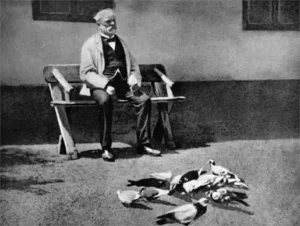
Dvořák completed his Eighth Symphony while on retreat with his family at his country home outside of Prague. Like many composers, he drew particular inspiration from nature. There, he had a garden that he tended religiously, and was able to devote time to one of his favorite hobbies: raising pigeons. Given this, it’s difficult not to hear bird calls in fluttering flute solos, or rolling hills and streams in the flowing melodies.
—Notes by Valerie Sly, 2026
[Thief, Poet, & Songs concert page]