
Levity
Starburst (2012)
Jessie Montgomery (b. 1981)
Run Time: Approx. 3 minutes
Jessie Montgomery is an American composer, violinist, and educator, and one of today’s most frequently performed living composers. Her work aims to capture the sound and spirit of the 21st-century American experience. She provides the following note for Starburst:
“This brief one-movement work for string orchestra is a play on imagery of rapidly changing musical colors. Exploding gestures are juxtaposed with gentle fleeting melodies in an attempt to create a multidimensional soundscape. A common definition of a starburst, “the rapid formation of large numbers of new stars in a galaxy at a rate high enough to alter the structure of the galaxy significantly,” lends itself almost literally to the nature of the performing ensemble that premiered the work, the Sphinx Virtuosi, and I wrote the piece with their dynamic in mind.”
I will add only that the Sphinx Virtuosi are an ensemble affiliated with the Sphinx Organization, which seeks to increase representation in classical music and promote arts access for underrepresented people. Starburst imagines exactly the change Sphinx hopes to create: an explosive infusion of voices too often unheard in the classical music world.
Serenade (after Plato’s Symposium) (1954)
Leonard Bernstein (1918-1990)
Run Time: Approx. 36 minutes
Leonard Bernstein is one of the most significant figures in the development of modern orchestral music. He was the first American-born conductor to serve as Music Director of the New York Philharmonic. His compositions have had a lasting presence in concert halls, opera houses, and on the Broadway stage. Over the course of his career, he won seven Emmy Awards, two Tony Awards, and sixteen Grammys. He became something of a celebrity following his televised exploration of Beethoven’s Fifth Symphony, the first of many such lectures that eventually included his beloved Young People’s Concerts. In my opinion, no one before or since has so effectively communicated the principals of classical music to a public audience. For anyone interested, the complete lectures are available on YouTube.
To get to what’s important in this piece, though, we can put aside his accomplishments and focus on the man himself. He was an intellectual. He loved literature and philosophy. He was a magnetic personality. A Jewish man who lived through World War II, he managed to remain a humanist and an optimist. Most importantly, he loved love. He loved his wife, he loved his children, and he loved men. He loved his friends and told them so effusively.
The letter below, from Bernstein to fellow composer Aaron Copland, is a touching example of his unabashed affection.
Dear A:
It’s two days before your birthday, but I’m already thinking hard and tenderly about you; and this note is your birthday present carrying with it such abiding love as I rarely if ever get to express to you in our occasional meetings. I don’t know if you’re aware of what you mean, have meant for 30 years, to me and my music and so many of my attitudes to life and to people. I suppose if there’s one person on earth who is at the center of my life it’s you; and day after day I recognize in my living your presence, your laugh, your peculiar mixture of intensity and calm…. I hope you live forever.
A long strong hug—
Lenny
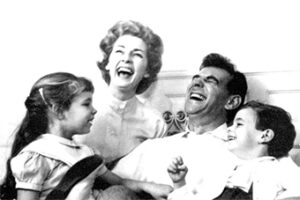
Leonard Bernstein with his wife Felicia and their children
Plato’s Symposium was a favorite of Lenny’s (as he was known to his friends) and, at least for a time, occupied a prime position on his bedside table. In the book, Plato imagines a gathering of seven prominent Athenian men around 416 BCE, who engage in a friendly competition of speeches in praise of Eros, the god of love and desire.
Though he later regretted changing the title from Symposium, a decision made to avoid accusations of pretension, the title he settled on, Serenade, is another allusion to love.The term means “evening music” from the italian sera, and dates to the medieval period when suitors would appear beneath the window of their beloved, armed with songs or poetry, like Romeo at Juliet’s balcony or John Cusack with his boombox in Say Anything.
Bernstein’s own program notes are a bit technical and heavily rely on the reader’s familiarity with Plato’s text. Just in case not everyone in the audience has had time to brush up on their Greek philosophy, I’ll offer a brief summary of each man’s thesis. It’s important to keep in mind that, while Bernstein was inspired by the arguments in his beloved text, Serenade is not an attempt to follow the story literally, but rather to evoke the spirit of each interpretation of love. Much like the flow of a debate, each subsequent movement picks up material from the previous one, expanding upon it and morphing it into a new argument.
Phaedrus
Eros is one of the oldest and most powerful gods. He emboldens us, causing us to do things we would not do for anyone else, even lay down our own lives.
Pausanius
There is a difference between common love, or physical desire, and heavenly love. Love is nobler when directed towards a person’s character and intellect, rather than their physical form. I should note that Pausanius builds his argument on the claim that any love a man feels for a woman is common because women are inherently inferior in mind and heart (a supposition to which I might be inclined to take offense.) Heavenly love, therefore, can exist only between two men of equal character. Outdated views aside, the point stands: heavenly love betters both parties.
Aristophanes – The Comic Playwright
Long ago, every human contained two people: two faces, four arms, and four legs. They could be two males, two females, or one male and one female. When these primordial humans threatened the gods, Zeus contained their power by slashing them in half. Now, every person must spend their life searching for the half with which they were originally united. Love is the desire to become whole.
Eryximachus – The Physician
Health is the harmonious relationship between opposing forces. Eros brings balance to the body and the world, promoting health and harmony in all beings.
Agathon – The Tragic Playwright
Eros imparts youth, beauty, and wisdom to everyone he touches. Love inspires peace rather than violence. It creates art, friendship, and virtue. Eros is beautiful and good, and so love makes us beautiful and good. Bernstein deemed this the most moving speech of the dialogue.
Socrates/Diotima
Socrates denounces Agathon as naive, claiming his version of love to be only what he wants it to be, not what it actually is. He then recalls a teaching from the seer Diotima, whom he visited years prior. Eros cannot be inherently beautiful and good because he is desire incarnate, and you can’t desire something you already possess. But he is a great god, so he cannot be ugly and bad. Instead, he is the bridge between good and bad, beautiful and ugly, and god and human. He is the desire for happiness.
Alcibiades – The Politician
Alcibiades drunkenly crashes the party, declaring his frustration at Socrates’ continued refusal of his advances. How could Socrates resist him? He is handsome, wealthy, and universally admired. Without intending to, Alcibiades illustrates many of the arguments that came before him. He proclaims his love to be more than physical, admiring Socrates’ mind. He longs for intimacy with Socrates, but he also longs for the wisdom and virtue that Socrates might impart on him. By refusing Alcibiades, Socrates fuels his desire, prolonging his love and proving his own point.
For this note, I’m inclined to skip my usual explanation of how the source material manifests in the composer’s musical choices. I think this piece has quite enough people opining without my adding to the fray. Instead, I encourage you to consider this work as an ode to love and all that it contains, whatever that means to you.
“What Bernstein surely meant us to understand was that his Serenade embodied all his loving feelings toward all his fellow human beings.” – Humphrey Burton
Symphony No. 2 in D major, Op. 73 (1877)
Johannes Brahms (1833-1897)
Run Time: Approx. 42 minutes
I’d like to begin this note by offering two photographs of Johannes Brahms. From the right stares the face most familiar to us: the bearded, austere man of his later decades. From the left peers a boyish young face that takes many people by surprise. Handsome, with piercing grey eyes, the young Brahms seems so distant from the composer we know now that he almost appears to be someone else entirely.
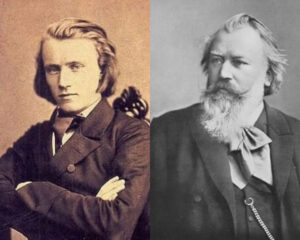
In the introduction to his biography of the composer, Jan Swafford joked that he privately referred to his book as Brahms ohne Bart—“Brahms without beard.” The formidable whiskers are an almost too-perfect embodiment of the man who worked hard to ensure that he would not be easily known. He never married, and he set out to destroy his correspondence and compositional sketches, intent on being remembered only through his music. Luckily, he did a slightly shoddy job of it, and enough material survives to form a reasonably full picture of who he was.
In the documents that escaped his fireplace and the accounts of those who knew him, we find a determinedly solitary and guarded man, but that is not what we hear in his music. When considering Brahms, I have often felt that I’m looking at two contradictory figures, a dichotomy Swafford so aptly captured in his quip about the man behind the beard.
His insistence on a tightly controlled life left him in a prison of his own making. He declared himself a happy bachelor, insisting that an artist must eschew personal attachments, yet we know that he was in love with Clara Schumann, his closest companion and the widow of his beloved mentor, Robert. He was reluctant to share his inner thoughts even with his dearest friends, yet his music is filled with earnest emotion.
He insisted that music should be absolute, possessing no story or program. Yet his scores are full of personal references: musical portraits of friends, private messages, and even cryptograms. He railed against Wagner and the direction in which he and his followers were pushing music, yet he kept a manuscript fragment of Wagner’s Tannhauser and quoted a theme from it in his Third Symphony.
As some audience members may recall from last season’s notes on the Third Symphony, Brahms adopted the credo Frei aber froh—“Free but happy,” as a response to his friend violinist Joseph Joachim’s motto, Frei aber einsam, “Free but lonely.” Both felt it their duty to overcome their passions, as Brahms put it, but at least Joachim, who did eventually marry, acknowledged there was a tradeoff.
I don’t buy Frei aber froh. It feels to me like he was trying—unsuccessfully—to convince himself of this. From the gulf between the bearded Brahms and the man beneath, emerges a restless desire that pervades his music. If there was a single word assigned to describe the ethos of his music, I believe that word would be longing. The feeling is ever present even in the ostensibly pastoral Second Symphony, tinging the work from its carefree opening through the triumphant final bars. This is no accident, but a carefully constructed tension that Brahms creates through his expert use of musical ambiguity.
What to listen for
Darker colors: trombones and timpani
In historical practice, trombones were largely absent from symphonies, appearing instead in sacred music. Attendees of our previous Masterworks concert might recall the somewhat striking orchestration of three trombones but no horns, flutes, or oboes. This would be nearly unheard of in a classical symphony, but in sacred oratorio it was standard practice.
In his First Symphony, Brahms withheld the trombones until the last movement, evoking the traditional use of the instruments with a chorale that echoes the sound of sacred music. In the Second Symphony, he releases the trombones from their traditional cage, using them instead to impart a bitter taste to the sweetness of the opening. As biographer Jan Swafford puts it, “Their quiet, ambiguous dissonance appears like a chilly shadow falling across a summer meadow.”
This may seem trivial, but Brahms actually received a letter from an audience member complaining that his use of the trombones and timpani ruined the symphony’s bright facade. “I have to confess,” the composer responded, “that I am a severely melancholic person, that black wings are constantly flapping above us, and that in my output—perhaps not entirely by chance—that symphony [the Second] is followed by a little essay about the great ‘Why.’ If you don’t know this, I will send it to you. It casts the necessary shadow on the serene symphony and perhaps accounts for those timpani and trombones.”
Harmonic Ambiguity
A quick music theory lesson:
We categorize chords largely by their stability: whether they sound complete, or how much they seem to want to move or resolve to another chord. Think of the poles of a magnet. Consonant intervals feel settled together, while dissonances create tension that seeks resolution to a more stable harmony.
Even different voicings of the same chord can have varying levels of stability, depending on which note is in the bass. We consider root-position tonic chords to be the most stable harmony. Put simply, if a piece is in C major, this would be a C major chord with a C in the lowest voice.
Brahms is a master of clouding his harmonic intentions. He often withholds clear resolutions for long periods of time. Dissonant chords are strung together, creating a restless feeling, and when he finally arrives at a resolution, he often chooses less stable versions of a chord, or adds notes to suggest a different harmony. Take the second theme of the first movement, for example. The melody is in A major, but his frequent emphasis of the note F-sharp, which does not belong to the A-major chord, makes us wonder, even if we don’t consciously know it: are we in A major or F-sharp minor? Essentially, is this happy or sad?
In the second movement, listen to the resolutions—the way the tension eases. Does it somehow feel incomplete? Here, Brahms withholds a root-position tonic chord for nearly the entire movement, not allowing us to fully exhale until the final measures.
Rhythmic Ambiguity
In the opening of the second movement, as the cellos play their languid, sighing melody, what meter do you think the music is in? On what beat in the measure does the music start? I wouldn’t know either if I hadn’t seen the score. This is a frequent device in Brahms’s music, one that keeps us unmoored and searching, perhaps echoing the “great why” he referred to in his letter. The combination of harmonic and rhythmic instability propels the music forward in its restless grappling, lending the resolutions even greater weight.
Please forgive the intellectual leap, but after spending considerable time trying to explain Socrates’ philosophy of love, I can’t help feeling that his argument is made manifest in Brahms’ work. What is this constant search for resolution, stability, and happiness if not desire? I think Socrates might say that Brahms understood love better than he realized.
—Notes by Valerie Sly, 2026