
9-minute read
Written by Valerie Sly, Alabama Symphony Orchestra, Principal Horn
Daniel Cho joined the ASO as Assistant Conductor during the 2023-24 Alabama Symphony season and was promoted to Associate Conductor in 2025. You’ve probably seen him on the podium or behind the scenes at an ASO event. In his capacity, he also serves as the director of the Alabama Symphony Youth Orchestra, so there’s a chance he’s worked with your kids or grandkids. So, what exactly does an assistant conductor do? The answer is: a lot.
During rehearsals where he’s not conducting, Daniel is our ears in the audience, listening to ensure that what we hear on stage translates into the hall. He’s looking at the score, monitoring for any mistakes that might be in our parts. You can often find me texting him during rehearsal breaks, asking things like, “Are the horns projecting enough at measure 75?” Or, “Are we sure that’s supposed to be an E-flat in measure 434?”
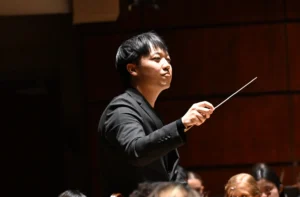
An assistant conductor is also an understudy, ready to step in and conduct the performance in case of emergency, but Daniel is also tasked with leading the orchestra for a myriad of pops, children’s, and outdoor concerts. This past season, he led his first masterworks programs, and next season, he’ll be at the helm for three more.
I sat down with Daniel to talk about his work with the ASO and ASYO, his background, and his thoughts on the importance of classical music. As tends to happen when you put two bona fide nerds in a room together, we also wandered into the weeds of music history, composers we love, and even a bit of music theory. As usual, I was struck by the infectious energy and passion that Daniel brings to everything he does, which is what I’ve tried most to capture in this profile.
From Violin to the Podium: Daniel Cho’s Early Musical Life
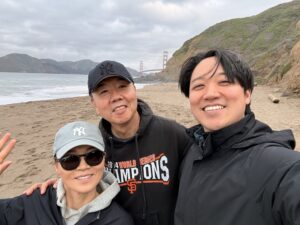
Daniel grew up in San Francisco, and like many kids, began playing an instrument at a young age. His mom started him on violin at age four because she had read in a parenting magazine that it might calm him down. “I think I was kind of a wild kid,” he says, “at least that’s what they tell me.” At first, he hated playing; it felt like a chore and he never wanted to practice. But then, at 11, he joined the Napa Valley Youth Symphony and fell in love with orchestra. “My mom tells me there was a noticeable difference when I started [in the orchestra]. She said, ‘You started practicing. I didn’t have to tell you to practice!’”
Part of this new engagement was the Youth Symphony’s director, Ming Luke, who Daniel says was the first to suggest that he might make a good conductor. “Ming was especially inspiring because he had a lot of joy for the music; you could just tell he loved it, and that made me love it. Also, he was an Asian man conducting, something I hadn’t seen up to that point, so naturally, I saw myself in him.”
That enthusiasm is part of why Daniel enjoys working with the students in the Alabama Symphony Youth Orchestra. “They’re just so excited about it,” he says. “They really want to learn, and they’re really, really focused.” While working with professionals is rewarding, Daniel says the pressure to execute a great performance can sometimes get intense, so he enjoys the freedom afforded by working with students. “There’s something about their excitement, especially during performances—it gets pretty rowdy musically, and it’s really fun watching them jump to a whole other level.”
New England Conservatory and the Path to Conducting
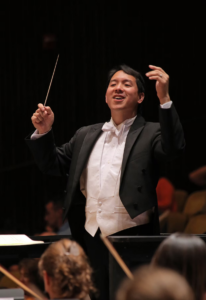
After high school, Daniel attended the New England Conservatory of Music for his undergraduate degree in violin performance, but the idea of conducting was always in the back of his mind. He found another mentor in the school’s Wind Ensemble director, Charles Peltz. “I was interested in conducting at that time,” Daniel says, “and he offered that I could join his conducting class, just as an auditor.” Daniel wound up earning his master’s degree in Wind Ensemble Conducting, an unusual choice for a string player. “At first I was kind of embarrassed about it, that it was a wind ensemble conducting degree, but now I’m very grateful I did that. I learned basic stuff I didn’t know about winds, brass, and percussion, and the repertoire for that ensemble is primarily 20th-century. It’s very complex, so it got my chops up doing mixed-meter and other difficult things.”
History, Context, and the Rabbit Holes That Make Classical Music Irresistible
When I ask whether he ever considered a career outside of music, Daniel and I can’t help but wander down our first rabbit hole. The only other path he ever seriously considered was history, “but classical music kind of covers that,” he says.
“Me, too,” I exclaim, “That was my other choice as well!” It’s the interconnectivity, we discover—how one event or one composer influences the next, that fascinates us both.
Now thoroughly distracted, I ask, “Do you ever listen to the podcast Hardcore History?”
“Yes!” It turns out Daniel is acquainted with Dan Carlin, the show’s host. He lives in Eugene, Oregon, and attends the Eugene Symphony, Daniel’s previous post. I fangirl for a moment before finding my way back to my point. “You know how he says he’s addicted to context?” I ask. “That’s how I feel. The idea that in order to explain one event, you have to back up centuries to find the beginning of the story.”
“We get a lot of that in music as well,” Daniel points out, “so I think it scratched that itch for me.” For him, the fact that classical music has been around for so long and has been worked by so many different hands makes it all the more powerful.
“When I think back to a person living [in another era],” he says, “especially as a Korean person, a child of Korean immigrants…my ancestors, while Beethoven was composing symphonies, were working in rice paddies. It might as well have been Jupiter, but their descendant is now living in the United States. When I listen to a Beethoven symphony, and I feel things, and then this person that I’m imagining, a random audience member sitting in a hall in 1770, listening to the premiere of [a Beethoven] symphony…I’m connected to that person. We’re both sitting here, and we’re both feeling this thing, listening to this thing. It’s probably very different in many ways, but we’re both feeling similar things. For me, that’s magic.”
The Impossible Question: Who’s Your Favorite Composer?
I shake myself out of the starry-eyed stupor that Daniel has just left me in to ask a question that every musician loathes to answer: Who’s your favorite composer?
That earns me some well-deserved griping. The problem, Daniel says, is that every time he works on something, he becomes convinced that it’s the greatest piece ever written. But eventually he acquiesces.
Structure, Twists, and Turns
“I guess as a conductor,” he says, “the one I always go back to is Brahms. “It’s got the structure and the puzzle-piece nature of Mozart or Haydn, but then it’s also got little twists and turns. So probably Brahms.” But then Daniel gets sucked into the same loop of reconsideration that overtakes every musician faced with this question. “But, also Britten comes to mind,” he reneges. Ravel, Mozart…how can you choose just one?” He punts it to me, and I balk at the taste of my own medicine.
“It depends on what day of the week it is,” I protest. Trying to pick a favorite composer, we decide, is a bit like trying to choose a favorite emotion. Each one offers something unique and important.
“And they’re all built on each other,” Daniel, too, is addicted to context, it seems.
Rewriting Music History
This leads me to my favorite question to ask musicians. “So many great composers died young,” I propose. “If you could go back in time and save one of them so they could write more, who would you save?” This, it turns out, is a much easier question for a musician to contemplate, and I’m rewarded with a quick and decisive answer.
“Probably Schubert,” Daniel says confidently. A small squeal escapes me before I can stop it—he was my pick, too. “He was so prolific already,” Daniel observes of the composer’s output during his short 31 years. “We’re so lucky to have so much from him, but he ended on the Cello Quintet, the late quartets, and then his latest songs. I think he was starting to really explore, and had gotten to the point where he gained confidence. And then he just…you know…got syphilis and died. Who among us?” We both laugh at that, but it’s not long before the topic of a young composer dying at the most intriguing part of their career brings us to Mozart, whose 40th symphony we had just performed.
And Then There is Mozart
As we discuss the various oddities of Mozart’s 40th symphony—the ways in which he pressed against the constraints of the classical form, I trot over to my bookshelf and pull down Mozart’s Last Year by H. C. Robbins Landon. “Can I borrow it?” asks Daniel. Of course he can! The book follows Mozart through exactly the tumultuous period we’ve been discussing. And because I can’t help myself, I pull down a couple more recently acquired tomes. I thunk Jan Swafford’s 1000-page biographies of Beethoven and Brahms down onto my kitchen table and Daniel lights up. “I became friends with him when I lived in Boston! My favorite thing about him is his basic philosophy, which is that we deify these people, and they are not [Gods], they’re just people. He writes from that angle.”
“This Music Is About You”: Daniel Cho on What Classical Music Really Means
As we chatted, I noticed a theme emerging: the unpretentious connectivity that defies how classical music is so often perceived. What’s most magnetic about this art, to Daniel, is that it captures the constancies of the human experience.
“I wish people knew that this music is about you,” he says. “It’s not some high-minded form. The people who wrote this music were human beings. You can clearly see the events of their lives affecting the music, and those events are the same as ours. It’s just difficulty, grief, joy, anger… it’s all the same stuff.” This is how Daniel wishes people thought of Classical music, instead of the powdered wigs and royal courts that so often caricaturize the genre. “Don’t think about that,” he pleads, “that’s not what it’s about. It’s about you.”
Why the Alabama Symphony Matters: Community, Identity, and Live Music
It’s not just the music itself that Daniel feels is important. After all, the internet age has made it so that anyone can go online and listen to the Berlin Philharmonic or Chicago Symphony at the click of a button. But, there’s a downside, he believes, to the growing homogenization that today’s conveniences bring. “Those little shops where you used to go grocery shopping, they’re all disappearing and being taken over by Target and Walmart and Publix. What makes this city [unique] is the Alabama Symphony, it’s the Birmingham Zoo, it’s the Alabama Ballet. In a world where places are losing their identity, I think that’s really important.”
What the ASO offers, then, is not just an opportunity to experience great art, but to do so together as part of this community. “I think what we actually present is less the point of what we do. It’s more about the experience, and the space that we provide for people to come together.”
The Case for Showing Up: What a Live Orchestra Concert Actually Does for You
Attending an orchestra concert, in Daniel’s mind, offers a prescription for so many of our modern afflictions—our short attention spans, the decline of quality time spent together, our obsession with our phones, even the AI-driven predilection for shortcuts. “Come to the hall,” he offers, “sit in the dark, and listen to music for an hour. It’s okay if your mind wanders, bring your mind back. Come be with hundreds of people just sitting together, listening, reacting to the musicians on stage who have spent years perfecting their craft. There’s no amplification and musicians are playing wooden and metal instruments made mostly by hand.”
When put that way, it sounds almost quaint, but Daniel believes this music and the people who perform it deserve the utmost respect, and he approaches his role at the front of the orchestra with that in mind. There are members of the orchestra, he notes, who have been performing longer than he’s been alive and have dedicated their lives to this art form. That, he says, is where the pressure comes from.
High-Pressure Performance
“I don’t think there are many fields that ask people to perform at such a high level just because. In sports, they get paid tens of millions of dollars. We put that same amount of pressure [on ourselves] just because this is important to us.” As the person on the podium who’s in charge of guiding the orchestra toward that standard, Daniel wants to make sure he’s worthy of the responsibility. The role of a conductor, to him, is a bit like that of a travel guide. He studies the cartography of the music to the level of a London Cabbie so that he can point the players towards the most important landmarks. But the musicians bring their own experience and ideas, so he views every gesture as an offer for a player to accept or decline. “Truly, you don’t have to listen to me!” he exclaims.
“I’m going to remember that,” I joke, but Daniel is serious. He says he prefers it that way because it means his ideas must be convincing and rooted in the score. “If I’m going to be up there,” he says, “there has to be a reason.”
Don’t Keep the ASO a Secret — It’s for Everyone
“Is there something you wish everyone in the state knew about the Alabama Symphony?” I ask.
“That we exist!” Daniel laughs, but he has a point—the ASO has been referred to as the “best kept secret in Alabama” in more than one article.
“I guess I would want people to know that these are people from your community, people you’ll see at the grocery store. They live here and they work every day to be ready to give a performance to you specifically.” And lest anyone wonder if Daniel understands the operational aspect of a conductor’s role, he adds that the ASO’s nonprofit status is hugely important to our identity. “The reason that we’re here is not to make money but to serve our community. The way that we function directly relies on the generosity of both small and large donors. Every dollar we receive is an investment in your community and will be put back into your community. That’s why we’re here.”
To Daniel, that personal connection matters most of all. “All I hear about is how crazy the world is. [The orchestra] is a place where you get to come to watch human endeavor. Your human connection, performing music that is about what is the best of us, and doing that together. It’s just the solution to everything. I believe that.”
References and Helpful Links:
For anyone who wants to explore some of the people, music, or books referenced in this interview, I’ve included links below.
Concerts to attend:
Daniel Cho will lead the ASO in three Masterworks programs next season. Concerts listed below.
November 6-7, 2026
Jesse Montgomery | Starburst
Leonard Bernstein | Serenade after Plato’s “Symposium”
Johannes Brahms | Symphony No. 2
March 19-20, 2027
Arturo Márquez | Danzón No. 7
Gustav Mahler | Blumine
Maurice Ravel | Mother Goose Suite
Ludwig von Beethoven | Symphony No. 7
May 7-8, 2027
Leonard Slatkin | Voyager 130
William Walton | Viola Concerto
Gustav Holst | The Planets
The ASO is excited to welcome guest conductor Ming Luke for our October Masterworks program.
October 23-24, 2026
Franz Schubert | Symphony No. 8 “Unfinished”
Johannes Brahms | Alto Rhapsody
Wolfgang Amadeus Mozart | Requiem in D minor
Explore our Masterworks season here
Suggested Music to listen to:
ASO performed this work in May, 2026. To read the program note from this performance, click here
Schubert’s late works
String Quintet in C Major, D 956
Referred to by Daniel in this article as the “Cello Quintet,” this was Schubert’s last piece of chamber music, completed just a few weeks before he died. The top comment on this video says “petition for Schubert to release a new album.” It seems more people than just the two of us wish he had lived to write a bit more.
String Quartet No. 15 in G Major (D. 887)
Schubert’s final song cycle sets 24 poems by Wilhelm Müller, following a heartbroken wanderer through a bleak midwinter landscape. Schubert’s landmark song cycles can be considered precursors to the modern concept album, uniting independent songs into a cohesive story.
Recommended Books/Podcasts:
Dan Carlin’s Hardcore History
Mozart’s Last Year by H.C. Robbins Landon
Books by Jan Swafford:
- Beethoven: Anguish and Triumph
- Johannes Brahms: A biography
—Article by Valerie Sly, Principal Horn, Symphony Volunteer Council Chair, June 2026